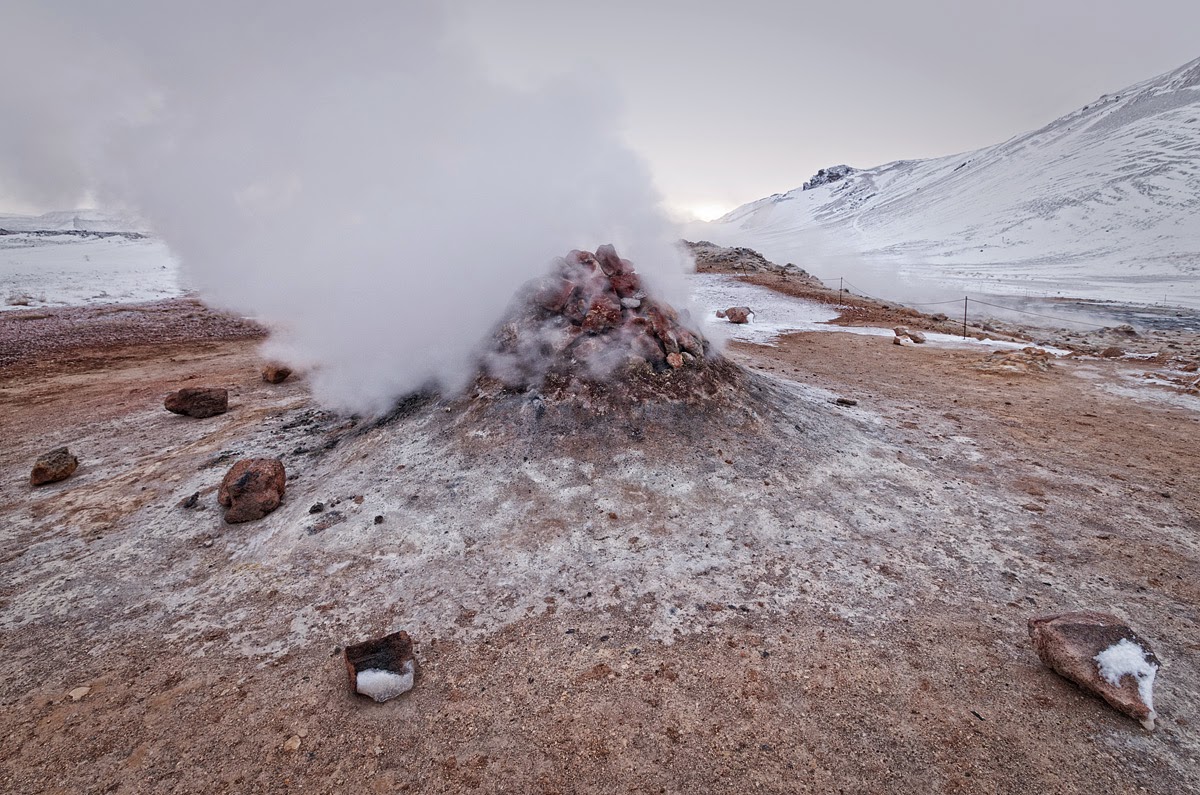
Here are some of the animals that live in the Brimstone Waste:
Crabs
Brown ones, white ones. Most are small (2-4") and roam in vast packs (1000+ individuals). These are harmless. Giant spider crabs hunt through the mudflats, too. For them, use stats for giant crabs, except that these guys raise themselves up on their stilt legs during combat, and can only be hit by reach weapons, at least until 1d4+1 of their 1HD legs have been smashed and they topple over.
Mudfish
You'll see herds of these guys, too, crawling across the landscape while gasping for air. The big ones are the size of ponies. They get pretty aggressive in the water, but will usually flee when you encounter them on land. Their gawping grin can swallow a halfling whole. They'll happily try to swallow larger prey, but will frequently choke to death on man-sized prey.
Terror Birds
Taller than an orc, these huge birds are predators of the first class. Poncy frothstalkers camouflage their bodies with mud and/or foam, and kill their prey by disemboweling them. Scintillant druni-birds kill their prey with axe-heavy pecks, and display their steely feathers in elaborate mating displays that can last for days. They have 3 HD, travel in packs of 2d6, and are basically just raptors that make turkey noises.
They are prized as pets, although they can never be fully tamed.
Dust Wyrms
These are degenerate cousins of dragons. Compared to true dragons, they are stupid, lazy, and cruel. They lurk in shallow dust-pits and hunt like crocodiles, and their death rolls are strong enough to tear a man in half. They have wicked brown teeth, and on quiet nights you can hear them clashing their armored coils together. They breath a cloud of toxic smoke and hot grit that deals 5d6 (save for half) and blinds the target for 1d6+1 rounds (separate save to negate). 7 HD and armor as plate.
Wise Parasites
These are diamond-shaped parasitic beetles, each about three feet long. They have a single red eye in the middle of their backs. They attach themselves to the sides of dust wyrms, where they live their entire lives, drinking blood from the huge reptile. Their names always include the name of the wyrm they are attached to, as well as their location on that wyrm (e.g. 'Locuhr's Elbow'). They are psychic, telepathic, and communicate with distant friends via the dreamscape. They use their influence to subtly influence the behavior of their host wyrm, and if a wyrm is heavily parasitized (20+ parasites) they have nearly fully control, and are able to calm a hungry wyrm, or direct it to attack distant enemies.
Wise parasites are revered as oracles, and people journey for hundreds of miles to speak to them. Some of their members are revered as oracles (such as the famous Diagun's Tail). In exchange, they sometimes want news, favors, or entertainment. But sometimes, they want nothing in exchange for their information, unlike human oracles. (Of course, getting through the Waste and the Wyrms is often challenge enough.)
Algae Mats
Sort of a primitive type of ooze, algae mats cover large areas, sometimes up to a quarter mile. They can be crossed, but only by running across them. Run any slower and you'll be pulled in and digested. Horses are also quickly eaten.
Lagodiles
Pastel-colored. They spit explosive bubbles.
Charbelchers
Fat-bellied frog-hounds. They belch hot cinders and build shallow tunnel systems. Their babies ride on their backs.
Brimstone Orcs
Brutal and militant, like all orcs, the brimstone orcs are famous for painting themselves white. Then they launch assaults amid dozens of thrown smoke bombs, which vent more white smoke that gives them cover. They also smoke poisonous cigars (which they are resistant to), and blow the toxic smoke in their opponent's eyes when in combat.
Coral Termites
They inhabit huge towers of land-coral. They repel invaders with fusillades of darts, and are a valuable source of protein in the Brimstone waste. Eating large amounts of termites causes crystallization of the eyeballs.
Saturday, November 8, 2014
Monday, October 27, 2014
New Biome: Brimstone Waste
In Hesaya cosmology, the Brimstone Waste is believed to be the literal entrance to hell. The souls of the wicked are carried there by birds, and are then deposited in the Great Caldera, where they pass on into the afterlife. (Compare this to the souls of the virtuous, who are carried out to sea along Greywing Bay.)
There are two commonly known facts that inform all aspects of the Waste. First are the clouds, smokes, and fogs. Visibility is highly variable, and while some days might bring blue skies (that allow you to see the pillars of smoke and steam emerging across the landscape), on other days the air is filled with ashen smoke, boiling steam, sulfur clouds, or poisonous gases.
Secondly, the food chain begins with bacteria, rather than plants. Most of the Brimestone Waste is too dark, too hot, too saline, or too sulfurous for plants to thrive there. And while the Waste is incredibly varied on a bacterial level, the average traveler will only notice the grey flakes atop another rippling mile of volcanic morphologies, or the yellow crust that dapples the side of tufa pillars. It's not a desert, but it looks like one.
The Great Caldera is a boiling lake. Well, that's not true. While it certainly has boiled in the past, it usually remains several degrees below. The water is sulfurous and pungent, and while it can be safely consumed, it tastes foul. Additionally, the water is believed to be corrupting (since it boils up from the pits of hell) and is sometimes exported for use as unholy water around the world. In the center of the lake is an island, which contains the Sealed Temple.
The Sealed Temple is believed to hold back the literal forces of hell. The temple itself is not large, and resembles a five-sided mausoleum, built from black marble, knotted and tense beneath the sloping shoulders of its pillared sides. Every year, the First Servant of the Authority ventures inside the Sealed Temple, reconsecrates it, and re-applies the white lead that holds the Great Seal in place. According to doctrine, the End of Days will begin with the opening of the Great Seal. The First Servant of the Authority has the crucial task of postponing the Apocalypse.
The Sarcophagus of the Great Seal is a metal dome that has been built around the Sealed Temple. It also includes the docks (full of steel-hulled boats), chapel, and knight's quarters. Traditionally, the Sarcophagus was home to a very small order of paladins, called the Leaden Order, but it is now believed that the Church has begun using golems to guard the Great Seal, and has begun relying less and less on the paladins.
The Hell Road was once a sort of aquaduct that traversed the Brimstone Waste. Back when the church had more financial solvency, it was able to keep the road in good repair, and it was a simple affair to travel to the Sealed Temple, simply by walking above the floods of poisonous foam and yellow banks of sulfur clouds. But now, orcish vandals have knocked down large sections of it, insane pilgrims have occupied other parts, and carnivorous birds have colonized other parts of this ruddy, stone road.
Pilgrim Enclaves are also common in the Brimstone Waste. For whatever reason, visiting the actual door to hell is an attractive proposition for all sorts of crazies, and numerous communities of the mentally ill dot the hellish landscape, ekeing out of a living by trawling for foamfish, and by licking the nutritious slime off of rocks. Enclaves tend to be full of millennial doomsday cults, would-be messiahs, or would-be antichrists.
Brimestone Orcs are also common. Their strong constitutions protect them from the worst of the heats and acids and blow through the Waste, and their short lifespan insulates them from the degenerate respiratory diseases that long-term inhabitants of the waste normally develop. Like all orcs, they are brutal and disrespectful. They sometimes fill hotsprings with blood, and then bathe in the boiling result before battle. They're also the only orc clans to practice execution by geyser.
![]() |
| they also call it the Grey Waste but the bacteria make many parts very colorful |
Mesas are the only places that are truly safe from the poisonous billows of the low lands. The tops of the mesas are lush, isolated, and home to a surprising amount of biodiversity.
Belchers are caves that spew black smoke. You'll hear lots of rumors about them, but they are devilishly hard to explore.
Chimneys are pillars of sulfurous accretions that tower over the landscape. Volcanically-heated water runs down the sides, full of dissolved minerals and heavy metals. They are easy to find, given the large amounts of steam that they give off. Bacterial forests are thickest here, and the jagged landscape is home to multitudes of small crabs that graze across the rocks.
The Church of the Old Earth is a small church, built into the side of a hydrothermal vent. Like the rest of the church-occupied Waste, it is intermittently staffed, and goes through cycles of abandonment and frugal repair.
The Choking Mountain is a landmark in the Waste. It's visible on windy days, but on most days it is obscured by the huge amounts of smoke the seep out through it's sides. Climbing a mountain is difficult, but climbing a smoke-covered mountain is nearly impossible. Which makes the metallic structure at it's apex all the more perplexing.
The Midnight Waste is formed by the smoke-shadow of the Choking Mountain. The mountain's smoke and local wind are so reliable, that the area downwind is plunged into permanent midnight. Frost covers the soot-stained stones, and black ice chokes the ravines. Nothing lives here except a clan of naus-garants, who have acted on the instructions of the Great Architect and built a alchemical laboratory-city inside the black ice.
The Sea of Foam is small, but it is notable for being the only stable source of the brown foam that periodically floods the mudflats. The Sea of Foam has some interesting things living on the bottom of it, that sometimes venture out when they get too hungry. The Sea of Foam is actually more dangerous than water, since you cannot swim in it nor breathe it. The orcs sometimes use specialized boats to traverse it. With a huge length and depth, the boats have a massive displacement. The orcs mostly use them to assist in small raids.
The Sky Reef can be found on one of the mud-flats near the Sea of Foam, where it is subject to almost-daily floods of foam and water. It resembles a marine reef, with calcified structures resembling fans, brains, ridges, and gnarls. The bacterial colonies that built this place are tended to by 1d6 druids of exceptional temperament. There are other small reefs on the flood plains of the Waste, but this is the largest one. There are other bacterial towers, too, but the largest ones can be found here.
Exports of the Brimstone Waste include: sulfur, mercury, lead, and titan gold.
Tuesday, October 14, 2014
Longstriders
Longstriders (a.k.a. longlanders) are either very tall people or very skinny giants. In fact, scholars refer to them as common giants.
They look like humans whose arms, legs, and torso have been doubled in length without getting much wider.
Common Knowledge
Longstriders are wanderers, and so you'll find them around the world, traveling in small bands or families. But a great deal of them also live around Revanwall, where nearly all of them have been forcibly integrated into human cities, where they serve as prestige slaves or honor guards. Their culture, names, and religions are the same as their master's.
In the past, they were the victims of a brutal genocide that killed over 60% of their numbers, with the remainder enslaved. But those days are mostly past, and enough longstriders have purchased their freedom in those centuries that they have sizable communities elsewhere, far from Revanwall.
In the Revanwall cities, you can still see their unmistakable bones used in various employs. For a brief moment, it was the height of popularity to have a scabbard made out of a longstrider's 3' long femur. Like coming back from from WW2 with a Luger. You'll also see their blue-tinged bones in walking sticks, pipes, sword-grips, chandeliers, scrimshaw . . . everywhere, really. Even ancient longstrider burial grounds have been exhumed, with the long bones harvested and the rest scattered.
Outside of Revanwall, most people know longstriders as travelling merchants. When they settle down in villages they tend to work physical jobs, like construction. Established families usually get into moneylending. They ride around on lightly-reskinned giraffes called longlander horses.
They are known for their sharp business sense and affability. They are so affable, in fact, that they won't even flinch when you bring out a scabbard made of longstrider bone and offer to sell it; they'll just start talking price, like any good merchant. People will tell you that they're completely honest, or they'll tell you that they're the greatest liars the world has ever seen, but no one has a moderate opinion of their honesty.
Uncommon Knowledge
The longlanders are a people without a history. Are they interested in investigating their old cities, trying to reclaim their lost culture and language? Nope. There isn't any old culture or language to discover. Anything to that effect was destroyed in the years since their enslavement.
This isn't to say that the longstriders haven't had "messiahs" or charismatic leaders that argued for a longstrider nation. But these calls for homeland and history have always ended in violence, genocide, and persecution. It is no wonder that modern longstriders have sought to distance themselves from these notions.
And so longstriders seem oddly incurious. If you ask one, "Don't you want to know where your family came from? Or where your home is?" The longstrider will answer, "My family are those around me that I trust, and my home is where I wish to sleep tonight." This is an answer which is both unusually tolerant and sadly close-minded. It's the response of a people who have fled their history.
Secret Knowledge
But there is something buried deep in the history of the longstriders. Something that they don't understand and don't trust.
Longstriders can transfer curses with their breath. They can literally inhale someone's curse, transferring it to themselves. And they can transfer a curse back into someone else just as easily.
This power is never discussed openly, and it is only used with great reservation. Many longstriders are ignorant of it themselves.
And when a longstrider eats the hearts of greater giantkin, their body undergoes a strange metamorphosis, and they develop potent powers. There are a few longstriders who mutter that these powers mean that they were meant to be rulers among giants, but they are quickly silenced. There is no suggestion more distasteful to the average longstrider than the notion that they are destined to be rulers.
Longstriders are humble with a passion and broadness that is incomprehensible to other races. This is because, wherever their long legs carry them, they are always guests or slaves. And arrogant guests do not survive long.
LONGSTRIDER CHARACTERS
They look like humans whose arms, legs, and torso have been doubled in length without getting much wider.
Common Knowledge
Longstriders are wanderers, and so you'll find them around the world, traveling in small bands or families. But a great deal of them also live around Revanwall, where nearly all of them have been forcibly integrated into human cities, where they serve as prestige slaves or honor guards. Their culture, names, and religions are the same as their master's.
In the past, they were the victims of a brutal genocide that killed over 60% of their numbers, with the remainder enslaved. But those days are mostly past, and enough longstriders have purchased their freedom in those centuries that they have sizable communities elsewhere, far from Revanwall.
In the Revanwall cities, you can still see their unmistakable bones used in various employs. For a brief moment, it was the height of popularity to have a scabbard made out of a longstrider's 3' long femur. Like coming back from from WW2 with a Luger. You'll also see their blue-tinged bones in walking sticks, pipes, sword-grips, chandeliers, scrimshaw . . . everywhere, really. Even ancient longstrider burial grounds have been exhumed, with the long bones harvested and the rest scattered.
![]() |
| I WANT TO RIDE A GIRAFFE |
They are known for their sharp business sense and affability. They are so affable, in fact, that they won't even flinch when you bring out a scabbard made of longstrider bone and offer to sell it; they'll just start talking price, like any good merchant. People will tell you that they're completely honest, or they'll tell you that they're the greatest liars the world has ever seen, but no one has a moderate opinion of their honesty.
![]() |
| I assumed this would be a common fetish, but I was wrong there's very few pictures of massively elongated people out there |
The longlanders are a people without a history. Are they interested in investigating their old cities, trying to reclaim their lost culture and language? Nope. There isn't any old culture or language to discover. Anything to that effect was destroyed in the years since their enslavement.
This isn't to say that the longstriders haven't had "messiahs" or charismatic leaders that argued for a longstrider nation. But these calls for homeland and history have always ended in violence, genocide, and persecution. It is no wonder that modern longstriders have sought to distance themselves from these notions.
And so longstriders seem oddly incurious. If you ask one, "Don't you want to know where your family came from? Or where your home is?" The longstrider will answer, "My family are those around me that I trust, and my home is where I wish to sleep tonight." This is an answer which is both unusually tolerant and sadly close-minded. It's the response of a people who have fled their history.
![]() |
| bayonetta is like 10' feet tall |
But there is something buried deep in the history of the longstriders. Something that they don't understand and don't trust.
Longstriders can transfer curses with their breath. They can literally inhale someone's curse, transferring it to themselves. And they can transfer a curse back into someone else just as easily.
This power is never discussed openly, and it is only used with great reservation. Many longstriders are ignorant of it themselves.
And when a longstrider eats the hearts of greater giantkin, their body undergoes a strange metamorphosis, and they develop potent powers. There are a few longstriders who mutter that these powers mean that they were meant to be rulers among giants, but they are quickly silenced. There is no suggestion more distasteful to the average longstrider than the notion that they are destined to be rulers.
Longstriders are humble with a passion and broadness that is incomprehensible to other races. This is because, wherever their long legs carry them, they are always guests or slaves. And arrogant guests do not survive long.
![]() |
| robert wadlow |
- Like a normal human, but stretched. 2x the height, 3x the weight.
- Most rooms and passages sized for humanoids count as cramped (-2 to hit).
- +100% range on thrown attacks.
- Can transfer curses to/from themselves via breath. Can inhale a curse from a target's lungs, or exhale a curse into a target's lungs. Unwilling targets must be restrained/asleep/unsuspecting, and get a save to resist. The first time an unwilling target makes a save, the curse is effectively locked in place (as far as this longstrider is concerned; other longstriders can still attempt).
- Metamorphosis. See below.
- Lifespan as human.
Metamorphosis: The first time a longstrider eats the heart of a giant with 4 HD or more, their eyes turn completely blue (pupil, iris, and sclera) and they can identify magic items as if they were a wizard of equal level. If they are already a wizard, they can identify magic items as if they were a level higher. Lifespan 2x human.
The first time a longstrider eats the heart of a giant with 7 HD or more, their hair falls out and their mucus membranes (lips, inside of the mouth, tongue, inside of eyelids, etc) turns milky white. They gain the use of a secret chest, which is more or less like the spell. It lets them store up to 5 items in an extradimensional bag inside their forehead. Lifespan 3x human.
The first time a longstrider eats the heart of a giant with 10 HD or more, their skin turns pure blue and their eyes glow as bright as a candle. They get telepathy with a range of 100'. Additionally, their breath can transfer all enchantments, not just curses. Lifespan 4x human.
Note: Think of them as fragile ogres. They have long, thin limbs that tend to shatter after falling, and they lack the great strength of their giant kin. Still, it seems a little odd to have 1 HD giants out there, so assume that any longstrider that you'll see in Centerra is a 3 HD peasant, at least. If one of your players wants to roll up a 1 HD longstrider teenager, let them. Option: add the caveat that three years need to go past before you can level up to 2 HD, and another 3 years before you can read 3 HD, or something like that.
![]() |
| POSSIBLUH RELATE? ONLY YOU CAN DECIDED! |
![]() |
| This book cost a dollar at the Dollar Store when I was a kid Fuckin' loved it Thanks for buying it for me, Mom. |
Monday, October 13, 2014
Least Priests, Pantheism, and God-Prisons
Isn't it cool how gods all seem to conflate power, worship, mythology, immortality, and a moral system? What happens if a god is lacking one of those elements?
That doesn't have to be the case, though.
A Partial History of Religion in Centerra
Before Hesaya became the dominant religion of Centerra, the continent was mostly pantheistic. One city-state would worship Magnificent Yakul, while the neighboring one would worship Grandfather Count-the-Days.
It is important to realize that, prior to the Advent of Hesaya, religion, ethnicity, and location were all tightly interrelated.
Every Land had a People, and every People had a God.
Some People had several Gods, sometimes People worshiped their neighbor's God, but each God was localized. Each one had a home.
It is also important to realize that a temple wasn't just a place that you go to worship your god, but is literally where your god resides.
Every temple has an inner sanctuary where the god lives, and from which the entire religion flows. And while a People/City/Relgion might have smaller, satellite sites of worship, there is never confusion that these are just shrines to the god, but not actual connections to the godhead.
In those days, most people didn't know what sort of land was over the next mountain range. It was understood that each land was a new one, with a new people and a new god. And each city's clerics performed miracles, so how could the divinity of their god be denied? And so most people were pantheists.
Religion wasn't something personal. There was no such thing as one's faith informing one's morals. Worship was a matter of politics and politeness. When in the city of Yakul, you worshipped Yakul. When in the city of Grandfather Count-the-Days, you worshipped him. And if a common man abandoned his city, his land, and his people, he rarely took his gods with him. How could he, when Yakul lived in his shrine in the mountain? And even if he did insist on worshipping Yakul in his new city, he would be far from the mountain, and Yakul would have difficulty hearing him. And so immigrants would always adopt the religion of their new city, at least partially, so as to avoid offending the god.
Religions didn't dictate morality. Or, if they did, it was usually couched in non-judgmental language, such as "Yakul is disgusted by thievery and the wearing of the color blue. Those who practice either will suffer his displeasure."
Likewise, old religions didn't have much truck with ontology. Although they often include creations myths or divine lineages for their people, they almost never attempt to explain the creation of the earth, nor what came before the world, nor the the afterlife. A religion was simply a formal system of observances that formalized the interaction between the god and the people, usually based on respect.
Old gods did not want worshipers. Why would they? What worth is the chatter of a few monkeys? Old religions did not proselytize, did not seek new converts. Your religion was your skin color. Your religion was your home.
And that was the state of the world until the Prophetess received the Command.
The Authority is the One True God, from whom all authority and truth flows. The Authority does not caution us from a sin because it is harmful for our souls, but instead a sin is harmful because the Authority has cautioned us against it.
The Birth of the Church
Unlike the other religions in the world, Hesaya worshipped an abstracted god. The Authority didn't have a shrine. The Authority didn't have a location, or a people. It was a perfect circle with no center, that encompassed everything. (This symbolism is why priest of Hesaya have black circles on the backs of their hands, either through a tattoo, henna, or a carefully embroidered glove.)
And while several other cults had emerged that had a similar theme of decentralization, Hesaya was the first one that actually caught on. Part of this had to do with how Hesaya treated other religions.
Most gods are jealous gods. Conquering a neighboring city-state invariably involves destroying their temple and destroying the idol in which the god lived. As you could expect, this was dangerous business. Genocide requires swords, destruction requires fire, but killing a god requires another god. And even then, the iconoclast is at risk from curses, infirmities, insanity, and death.
Hesaya was remarkable because the Prophetess taught that all gods were merely aspects of the Authority. Competing gods should be worshipped, rather than destroyed. It was a sin to kill a god, even one that opposed the Authority.
With this message of peace and assimilation, Hesaya quickly became the dominant religion on the continent. (Also banking and prophecy, the two most profitable industries in the world.)
This isn't to say that the early church was peaceful (their paladins filled many mass graves) or that they assimilated all the gods they came across (the Hammer of Iconoclasm has supposedly killed 777 separate gods by smashing their idols). But tolerance was the rhetoric, anyway.
Coramont
The city of Coramont was where the Prophetess was born, and now it has become a metropolis of its own, an economic and military powerhouse. No king is crowned except with Coramont's permission. There is a street in Coramont called the Street of Lesser Gods. This is where all of the defeated gods reside.
(It's also where the living reincarnation of the Prophetess Essa lives, may we be worthy. She's ten.)
When a city/people/god bends its knee to Coramont, and swears eternal loyalty to the Authority, the Church consolidates that pledge. The god's church is taken apart, stone by stone, and shipped to the capitol of Coramont. The defeated god's idol is taken into the city, where it is honored. It is paraded through the streets and anointed with oils. Huge banquets are held, and at the head of the table is placed the idol (and therefor the god who lives inside it). Even the patriarch bows to the least idol.
And then the defeated god's temple is rebuilt on the Street of Lesser Gods, and the idol is returned to it's place inside the sanctuary. The temple is reconsecrated.
But there are still people that say a god belongs with its people, and that it is blasphemy to remove a god from his land. Those people are quietly executed and buried in unmarked graves far from Coramont.
The purpose of this is political as well as religious. The defeated god has become a hostage. If the defeated city wishes to worship their god, they must come to Coramont to do it. Aside from the taxes and levies imposed on the client state, the Patriarch can now keep a close eye on the lesser priests.
And in the space of a few generations, the priestly family of their client states became urbanized. The priests dressed, spoke, and socialized as if they were from Coramont. Any further rebellions from the outlying cities would have no support from their own churches.
In the 800 year history of Coramont, the city has managed to collect quite a number of gods. The Street of Lesser Gods contains no less than 1404 "official" gods.
(Digression: for most of it's history, "Coramont" was synonymous with "The Church", but now a very quiet schism is dividing the church. Coramont and the Prophetess frequently disagree with the Patriarch in Kaladon.)
But years are long, and memories short. As incredible as it may seem, entire temples and gods seem to have disappeared over the centuries. After a bloody war with Coramont, after thousands of young men have been laid in the earth, after noble speeches about pride and patriotism, entire cultures have vanished without so much as a whimper.
And the idols turn up in the most unlikely of places. If you go into the Lucky Duck tavern in Coramont and sneak into the basement, you'll find a small shrine to Devonura, Who Makes the Green Things Grow. And at the intersection of Bassinet and Bane, you'll find a snow-white boulder whose surface has been carved out into a maze of alcoves and short tunnels filled with figurines. This boulder is the home of Rashimar, a river god associated with towers and poisonous fish.
(Digression: In Hesaya, lesser gods are respected, and they are sometimes even honored by ritual or song. It is even permissible to pray to a lesser god, with the understanding that the lesser god will act as an intermediary. But only the Authority has the authority to grant prayers, and only the Authority is worshipped.)
The religions of these client gods have withered. Their priesthood has atrophied. Sometimes, a lesser temple will be tended by a shriveled old man and his inbred nephew. Or it will be tended by a toothless immigrant, who doesn't speak a word of Common. But just as commonly, the lesser temple will sit empty.
Least Priests
But every god must be worshipped. This was the covenant that the Patriarchs made so long ago. And so the empty shrines are tended by least priests. Their job is to go to an abandoned temple, perform the rituals, pray to that forgotten godling sincerely and fervently, and then go on.
Least priests are bit like those home care workers, who go around bringing groceries to retirees too fragile to leave the house. It's a tough job. They need to clean the place up (no one else will do it) and explain to the god that it's okay, your grandchildren are probably just very busy--it doesn't mean that they don't love you and think about you.
Metagaming: Since a least cleric might find their prayers answered by any of the various gods that they worship, a Hesayan cleric PC can be snake-themed or sex-themed or whatever. The Authority has many incarnations in the world. It also explains how you can have a snake-cleric and a sex-cleric in the same party together. Players can even make up their own client gods.
Digression: Training to be a Hesayan cleric often includes praying to all sorts of client gods, in order to find out if any of them can answer your prayers with appropriate miracles. Or, technically, relay the Authority's miracles.
The Desmoterion
While cooperative gods are given places of honor on the Street of Lesser Gods, and rebellious gods are shattered by the Hammer of Iconoclasm, sometimes neither of those solutions is ideal. Every god is unique, after all.
Sometimes the Church fears the retribution that would arise from destroying the god's idol.
Sometimes the Church wishes to punish a god for rebelling, or for heresy.
Sometimes the Church wants to keep a god isolated until it can be convinced to join more willingly.
Whatever the cause, there is a place beneath Coramont called the Place of Chains, Desmoterion. It has been built in secret over the centuries, bits and pieces. Some parts are precise and carefully engineered. Some parts are haphazard and chaotic. All of it was built under the orders of different Patriarchs, in different eras, in order to imprison gods.
The Desmoterion is secret and it is full of traps, treasure, forgotten gods, and even a few political prisoners. This dungeon contains the Hammer of Iconoclasm, immortal paladins, and a tentacled monstrosity that you can't help but feel sorry for. I want it to be a dungeon for level 1 PCs.
Blasphemy
Only a fool mocks a god.
Whenever a player openly insults a god by cursing them, doubting them, or ridiculing them, they have a chance to suffer a curse. The chance of suffering this depends on how close they are to the god's location.
The the blasphemy was insincere or accidental, the chance of suffering a curse is halved. There is also no chance of suffering a curse if the speaker is currently protected by another god. Therefore, clerics can curse other gods without fear of repercussion, and any who is inside Yakul's shrine can curse the enemies of Yakul.
If a person is in Yakul's shrine and curses a god that Yakul doesn't feel strongly about one way or the other, they will not be protected against the insulted god's wrath.
Curse Table
1 Baleful Polymorph
2 Blindness
3 Crippled Leg
4 Withered Arm
5 Marked (no religious person will help you, sell to you, buy from you, or serve you)
6 Cannot Gain XP
7 Permanent Insanity (traditionally, this is a thematically appropriate phobia)
8 Leprosy (or other horrible, permanent disease)
9* Loss of All Wealth (occurs in the next 7 days, even if wealth hidden or transferred)
10* Loss of Favorite Family Member or Animal (traditionally death)
11* Attacked by Divine Agent (occurs in the next 7 days)
12* Save or Die (traditionally, this is a lightning bolt)
*Results 9-12 are not permanent curses but instead single, horrible things that happen to a PC. They don't linger.
This curse can only be lifted by a cleric. The cleric can see that the curse is divine in nature, and that the person incurred it by blasphemy. The cleric will also know that they can invoke the punishing god's anger by extension if they remove the curse, and although Yakul will not strike the cleric dead for removing Yakul's curse, this expenditure of divine currency will echo in the spirit realm. Remember that the cleric didn't remove Yakul's curse--the cleric's god did. This has political implications between the two gods, so the cleric may be unwilling to remove a divine curse. Remember that all clerics respect all gods, even the gods that they hate.
A cleric can also be cursed by their own god if the offense is large enough. This doesn't necessarily mean that the cleric loses their powers--sometimes a god needs to punish its agent without removing it.
Clarification of Terms
For the purposes of this discussion, I've used the word "god" to mean anything that is worshipped and has the capacity to grant clerical powers. In Centerra, that's a pretty loose definition. There are even nature spirits who meet those definition. Hell, there are even mortal humans who can meet that definition.
Outsider of the scope of this article, there's much weirder stuff in Centerra there that could be called a god. Some of those things shun worship. Some of them shun clerics.
That doesn't have to be the case, though.
A Partial History of Religion in Centerra
Before Hesaya became the dominant religion of Centerra, the continent was mostly pantheistic. One city-state would worship Magnificent Yakul, while the neighboring one would worship Grandfather Count-the-Days.
It is important to realize that, prior to the Advent of Hesaya, religion, ethnicity, and location were all tightly interrelated.
Every Land had a People, and every People had a God.
Some People had several Gods, sometimes People worshiped their neighbor's God, but each God was localized. Each one had a home.
It is also important to realize that a temple wasn't just a place that you go to worship your god, but is literally where your god resides.
Every temple has an inner sanctuary where the god lives, and from which the entire religion flows. And while a People/City/Relgion might have smaller, satellite sites of worship, there is never confusion that these are just shrines to the god, but not actual connections to the godhead.
In those days, most people didn't know what sort of land was over the next mountain range. It was understood that each land was a new one, with a new people and a new god. And each city's clerics performed miracles, so how could the divinity of their god be denied? And so most people were pantheists.
Religion wasn't something personal. There was no such thing as one's faith informing one's morals. Worship was a matter of politics and politeness. When in the city of Yakul, you worshipped Yakul. When in the city of Grandfather Count-the-Days, you worshipped him. And if a common man abandoned his city, his land, and his people, he rarely took his gods with him. How could he, when Yakul lived in his shrine in the mountain? And even if he did insist on worshipping Yakul in his new city, he would be far from the mountain, and Yakul would have difficulty hearing him. And so immigrants would always adopt the religion of their new city, at least partially, so as to avoid offending the god.
Religions didn't dictate morality. Or, if they did, it was usually couched in non-judgmental language, such as "Yakul is disgusted by thievery and the wearing of the color blue. Those who practice either will suffer his displeasure."
Likewise, old religions didn't have much truck with ontology. Although they often include creations myths or divine lineages for their people, they almost never attempt to explain the creation of the earth, nor what came before the world, nor the the afterlife. A religion was simply a formal system of observances that formalized the interaction between the god and the people, usually based on respect.
Old gods did not want worshipers. Why would they? What worth is the chatter of a few monkeys? Old religions did not proselytize, did not seek new converts. Your religion was your skin color. Your religion was your home.
And that was the state of the world until the Prophetess received the Command.
Honor the Authority, the God of Gods, from Whom all Truth flows.
<digression> The name of the Authority is Akatom, but it is only invoked in the most sacred of ceremonies. A more common name for him is Dumadiyei. But most folks call him the Authority.</digression>
Unlike the other religions in the world, Hesaya worshipped an abstracted god. The Authority didn't have a shrine. The Authority didn't have a location, or a people. It was a perfect circle with no center, that encompassed everything. (This symbolism is why priest of Hesaya have black circles on the backs of their hands, either through a tattoo, henna, or a carefully embroidered glove.)
And while several other cults had emerged that had a similar theme of decentralization, Hesaya was the first one that actually caught on. Part of this had to do with how Hesaya treated other religions.
Most gods are jealous gods. Conquering a neighboring city-state invariably involves destroying their temple and destroying the idol in which the god lived. As you could expect, this was dangerous business. Genocide requires swords, destruction requires fire, but killing a god requires another god. And even then, the iconoclast is at risk from curses, infirmities, insanity, and death.
Hesaya was remarkable because the Prophetess taught that all gods were merely aspects of the Authority. Competing gods should be worshipped, rather than destroyed. It was a sin to kill a god, even one that opposed the Authority.
With this message of peace and assimilation, Hesaya quickly became the dominant religion on the continent. (Also banking and prophecy, the two most profitable industries in the world.)
This isn't to say that the early church was peaceful (their paladins filled many mass graves) or that they assimilated all the gods they came across (the Hammer of Iconoclasm has supposedly killed 777 separate gods by smashing their idols). But tolerance was the rhetoric, anyway.
Coramont
The city of Coramont was where the Prophetess was born, and now it has become a metropolis of its own, an economic and military powerhouse. No king is crowned except with Coramont's permission. There is a street in Coramont called the Street of Lesser Gods. This is where all of the defeated gods reside.
(It's also where the living reincarnation of the Prophetess Essa lives, may we be worthy. She's ten.)
When a city/people/god bends its knee to Coramont, and swears eternal loyalty to the Authority, the Church consolidates that pledge. The god's church is taken apart, stone by stone, and shipped to the capitol of Coramont. The defeated god's idol is taken into the city, where it is honored. It is paraded through the streets and anointed with oils. Huge banquets are held, and at the head of the table is placed the idol (and therefor the god who lives inside it). Even the patriarch bows to the least idol.
And then the defeated god's temple is rebuilt on the Street of Lesser Gods, and the idol is returned to it's place inside the sanctuary. The temple is reconsecrated.
But there are still people that say a god belongs with its people, and that it is blasphemy to remove a god from his land. Those people are quietly executed and buried in unmarked graves far from Coramont.
The purpose of this is political as well as religious. The defeated god has become a hostage. If the defeated city wishes to worship their god, they must come to Coramont to do it. Aside from the taxes and levies imposed on the client state, the Patriarch can now keep a close eye on the lesser priests.
And in the space of a few generations, the priestly family of their client states became urbanized. The priests dressed, spoke, and socialized as if they were from Coramont. Any further rebellions from the outlying cities would have no support from their own churches.
In the 800 year history of Coramont, the city has managed to collect quite a number of gods. The Street of Lesser Gods contains no less than 1404 "official" gods.
(Digression: for most of it's history, "Coramont" was synonymous with "The Church", but now a very quiet schism is dividing the church. Coramont and the Prophetess frequently disagree with the Patriarch in Kaladon.)
But years are long, and memories short. As incredible as it may seem, entire temples and gods seem to have disappeared over the centuries. After a bloody war with Coramont, after thousands of young men have been laid in the earth, after noble speeches about pride and patriotism, entire cultures have vanished without so much as a whimper.
And the idols turn up in the most unlikely of places. If you go into the Lucky Duck tavern in Coramont and sneak into the basement, you'll find a small shrine to Devonura, Who Makes the Green Things Grow. And at the intersection of Bassinet and Bane, you'll find a snow-white boulder whose surface has been carved out into a maze of alcoves and short tunnels filled with figurines. This boulder is the home of Rashimar, a river god associated with towers and poisonous fish.
(Digression: In Hesaya, lesser gods are respected, and they are sometimes even honored by ritual or song. It is even permissible to pray to a lesser god, with the understanding that the lesser god will act as an intermediary. But only the Authority has the authority to grant prayers, and only the Authority is worshipped.)
The religions of these client gods have withered. Their priesthood has atrophied. Sometimes, a lesser temple will be tended by a shriveled old man and his inbred nephew. Or it will be tended by a toothless immigrant, who doesn't speak a word of Common. But just as commonly, the lesser temple will sit empty.
Least Priests
But every god must be worshipped. This was the covenant that the Patriarchs made so long ago. And so the empty shrines are tended by least priests. Their job is to go to an abandoned temple, perform the rituals, pray to that forgotten godling sincerely and fervently, and then go on.
Least priests are bit like those home care workers, who go around bringing groceries to retirees too fragile to leave the house. It's a tough job. They need to clean the place up (no one else will do it) and explain to the god that it's okay, your grandchildren are probably just very busy--it doesn't mean that they don't love you and think about you.
It's a bit sad, but it's also a bit weird, because of the diversity of gods involved. It's also sometimes exhausting. Example:
- On Monday, you spend ten hours imbibing hallucinogens and writhing in ecstasy beneath Hakum-Keth, the snake god. You spend your day's earnings on a massage afterwards.
- On Tuesday, you cover yourself in honey and walk figure eights between the stone hives of the Nameless Insect. Although there are no insects (apparently), you still wake up with bites covering your body in auspicious patterns.
- On Wednesday, you meditate at the bottom of a well while tolling a bell every six minutes, for three hours. You would have finished quicker if you didn't fall asleep and have to restart.
- On Thursday, you meet up with your partner to glorify Hasdrubal the Pugnacious with five hours of valiant combat (with padded swords). By nightfall, you'll have a new crop of shiny bruises.
- On Friday, you meet up with the same partner for six hours of tantric sex atop a wooden elephant. You curse the priest you decided that sex-day should come after combat-day.
- On Saturday, go to the Grand Cathedral to worship the Authority directly. Before you can go to sleep, however, you must light six candles made from six different substances for six different forest spirits.
- On Sunday, you stay in bed, because you're exhausted. But what can you do? The gods must be honored.
Metagaming: Since a least cleric might find their prayers answered by any of the various gods that they worship, a Hesayan cleric PC can be snake-themed or sex-themed or whatever. The Authority has many incarnations in the world. It also explains how you can have a snake-cleric and a sex-cleric in the same party together. Players can even make up their own client gods.
Digression: Training to be a Hesayan cleric often includes praying to all sorts of client gods, in order to find out if any of them can answer your prayers with appropriate miracles. Or, technically, relay the Authority's miracles.
The Desmoterion
While cooperative gods are given places of honor on the Street of Lesser Gods, and rebellious gods are shattered by the Hammer of Iconoclasm, sometimes neither of those solutions is ideal. Every god is unique, after all.
Sometimes the Church fears the retribution that would arise from destroying the god's idol.
Sometimes the Church wishes to punish a god for rebelling, or for heresy.
Sometimes the Church wants to keep a god isolated until it can be convinced to join more willingly.
Whatever the cause, there is a place beneath Coramont called the Place of Chains, Desmoterion. It has been built in secret over the centuries, bits and pieces. Some parts are precise and carefully engineered. Some parts are haphazard and chaotic. All of it was built under the orders of different Patriarchs, in different eras, in order to imprison gods.
The Desmoterion is secret and it is full of traps, treasure, forgotten gods, and even a few political prisoners. This dungeon contains the Hammer of Iconoclasm, immortal paladins, and a tentacled monstrosity that you can't help but feel sorry for. I want it to be a dungeon for level 1 PCs.
Only a fool mocks a god.
Whenever a player openly insults a god by cursing them, doubting them, or ridiculing them, they have a chance to suffer a curse. The chance of suffering this depends on how close they are to the god's location.
- In god's own temple: 70% chance of curse
- In god's own city: 50% chance of curse
- In god's own land: 30% chance of curse
- Anywhere else in the world: 10% chance of curse.
The the blasphemy was insincere or accidental, the chance of suffering a curse is halved. There is also no chance of suffering a curse if the speaker is currently protected by another god. Therefore, clerics can curse other gods without fear of repercussion, and any who is inside Yakul's shrine can curse the enemies of Yakul.
If a person is in Yakul's shrine and curses a god that Yakul doesn't feel strongly about one way or the other, they will not be protected against the insulted god's wrath.
Curse Table
1 Baleful Polymorph
2 Blindness
3 Crippled Leg
4 Withered Arm
5 Marked (no religious person will help you, sell to you, buy from you, or serve you)
6 Cannot Gain XP
7 Permanent Insanity (traditionally, this is a thematically appropriate phobia)
8 Leprosy (or other horrible, permanent disease)
9* Loss of All Wealth (occurs in the next 7 days, even if wealth hidden or transferred)
10* Loss of Favorite Family Member or Animal (traditionally death)
11* Attacked by Divine Agent (occurs in the next 7 days)
12* Save or Die (traditionally, this is a lightning bolt)
This curse can only be lifted by a cleric. The cleric can see that the curse is divine in nature, and that the person incurred it by blasphemy. The cleric will also know that they can invoke the punishing god's anger by extension if they remove the curse, and although Yakul will not strike the cleric dead for removing Yakul's curse, this expenditure of divine currency will echo in the spirit realm. Remember that the cleric didn't remove Yakul's curse--the cleric's god did. This has political implications between the two gods, so the cleric may be unwilling to remove a divine curse. Remember that all clerics respect all gods, even the gods that they hate.
A cleric can also be cursed by their own god if the offense is large enough. This doesn't necessarily mean that the cleric loses their powers--sometimes a god needs to punish its agent without removing it.
Clarification of Terms
For the purposes of this discussion, I've used the word "god" to mean anything that is worshipped and has the capacity to grant clerical powers. In Centerra, that's a pretty loose definition. There are even nature spirits who meet those definition. Hell, there are even mortal humans who can meet that definition.
Outsider of the scope of this article, there's much weirder stuff in Centerra there that could be called a god. Some of those things shun worship. Some of them shun clerics.
Saturday, October 11, 2014
Expectations and Entitlement Among Millennial Roleplayers
Millennials
If you want to read up on it yourself, there's plenty of opinions out there (1 2 3). Just remember to (a) check your sources, and (b) look for statistical trends, not just anecdotes or stats about a single generation.
Anyway, here's my idle, purely speculative hypothesis: these same generational trends have been shaping how we play our RPGs, too.
Is player entitlement a new thing? Do players show up and expect that. . .
- their character will be treated like a hero?
- their encounters will be balanced to their level?
- they'll all get equal spotlight time?
- they'll all get equal loot that's also class-appropriate for them?
- the campaign will revolve around them and their story?
- . . . and does that include some insurance against permanent character death?
- . . . and the stakes are plot elements, rather than player death?
- they'll have opportunities to take a more literal hand in telling the story (fleshing out scene details, deciding backstories for minor NPCs)?
And if so, are these new trends? I'm going to argue Yes.
Entitlement
I think these are all expectations that cater to player entitlement. Convenience, respect, control. These are concessions to player expectations.
Numenera lets players bid on the fiction using Intrusions and XP. Dungeon World offers players more literal ways to write their own story, aside from just the actions of their character. Later incarnations of DnD have made recovering from permanent death a trivial task. Some 4e DMs allow players to pick what loot is in the next treasure chest, since character builds are so important. Games have a specific calculus that they use to ensure that a particular combat is level-appropriate.
I know a lot of grognards sigh and shake their heads at this stuff. Well, cut it the fuck out. There's no wrong way to have fun. These are just signs of a changing time. So what if players demand a more personal level of customer satisfaction these days? These are great innovations that I'm glad have been added to the repertoire of tabletop RPGs. There's a reason these games have gained in popularity.
These trends don't really become odious until they fall into the deepest abysms of player pandering, when the game becomes a power trip for the players, and the DM is probably better off just giving everyone a hand job.
But remember that the inverse has also been a criticism of our hobby. Callous DMs who didn't care about the players at all. Cheap, meaningless deaths. Insurmountable results from the wandering monsters table. Illogical traps that killed without so much as a saving throw. DM NPCs that overshadowed the players at every step of the way.
So it swings both ways. And everyone is going to have a different equilibrium within that spectrum, somewhere between "my character chooses to spend a plot point to avoid dying, since she hasn't avenged her family yet" and "hahaha give me your character sheet so I can eat it".
My Personal Preferences
As for me, I tend to shy away from games that offer too many of my bulletpoints, above. I like old-school. I don't want to be a special snowflake. I want to be a pebble. I like save or die mechanics. I like roguelikes.
Roguelikes, by the way, are almost the direct opposite of modern trends towards player entitlement. Everything is random, difficult, and utterly unsympathetic. But that's part of the appeal. All those brutal failures make victory so much sweeter when it finally occurs.
I remember playing in a game of +Courtney Campbell's where we were forced to lick a demon's boot. That's about as far from playing a power fantasy as you can get. It's funny--it didn't cost me any HP or GP to say, "I lick the demon's boot and beg." but I still found it distasteful. (Too much empathy with your PC is always a dangerous thing.) I wonder how many players have chosen to fight a doomed fight rather than merely swallow their pride? Or more accurately, the imagined pride of an imagined avatar?
But looking back at it now, it was a pretty cool part of the game. Heroes are never forced to grovel, nowadays, and that scarcity made it dramatic. And in a callous way, realistic. Outside of idealized fantasy, sometimes a dude needs to kiss a lot of ass.
(Out of curiosity, are there any videogames where the protagonist has to humiliate themselves? Not just some cut scene where the PC does something humiliating, but an actual choice that the player makes to humiliate themselves? Like, do you lick the warchief's boot clean or lose all of your money?)
Anyway, this might be one of the roots behind the old/new school schism. But if so, that's great news, because it's just a matter of player+GM expectations. And that means they can be discussed and agreed upon, because that's something that adults do.
UPDATE: There's a good response to this post over at Incredible Vehicle that's gives some thoughtful criticism.
Subscribe to:
Posts (Atom)


.jpg)