Tuesday, February 28, 2017

The Cave of the Druid

This is a mini-dungeon.  Plop it down wherever there is a forest.

Why is the Party Going Here?

  1. They could always stumble across it, in true Vancian fashion.
  2. They might want a question answered, or a favor returned.
  3. They might be seeking revenge against the high druid, or looking to take hostages to use as bargaining chips against him.
  4. Hell, maybe they want someone resurrected via wolf.

The Approach

The forest around the thicket is full of Irritable Trees.  The party will encounter 1d6 of them on the way there, or 1d4 if they avoid the most obvious path.

If the party is belligerent (loud, carrying fire, visible axes, threatening the forest, attacking trees) they will be attacked by an additional 1d4 Hateful Trees and 1 HD 8 Treant.  The party will not be attacked if they show deference to the trees (e.g. avoiding their roots, addressing the trees with terms of respect, asking permission, leaving axes behind) they'll get attacked by one less tree for each action taken.

Irritable Tree

HD 8  AC none  No Attacks
Move 0  Int 8  Morale 12

Drop Branch - Take 1d12 damage if you fail a Movement check.  Usable 1/day.

Irritable trees will drop their branch on the first person in the group (50%) or a random person in the group (50%).

Irritable trees sleep at night.  Duh.

Being aggressive towards the forest is a very terrible idea.  It's a bit like attacking a city, while you are in the middle of the city and vastly outnumbered.

The average tree strongly dislikes humans (-4 to reaction rolls).  Humans are things with the metal bites and the domesticated fire.

Trees are slow things, with thoughts that flow like thick sap.  To them, humans are as fast and as ephemeral as gnats.  Fire moves as fast as an explosion.  Chopping down a tree happens as fast as they can react, and is an act of sudden, unexpected horror, more similar to being struck by lightning than an act of premeditated malice.

With the egocentrism common to pretty much all sentient species, the subject of human sentience is the subject of both ridicule and speculation among trees.

the Cave of the Evil Spirit, Niagara Falls

The Cave Mouth

A bloodstained menhir.  Biting flies cause pain but no damage.  Parties would be forgiven for thinking that the real danger is a fly swarm.  The flies attack anyone who is not sufficiently dirty; if the players have been living rough for at least a week, they may pass the flies unmolested.

The guardian of the cave mouth is a Hateful Tree.  It doesn't let anyone into the save except those that it recognizes, and the only people it recognizes are the High Druid and his family.

Off to the right is a refuse pile (mostly plant waste and feces).  The party can hear a stream a few hundred feet off to the right.

Animals avoid this place unless they are here to petition the druid for some favor.  Roll a d4 to see if an animal is waiting a respectable distance away:

1  No animals are waiting here.
2 A wolf is here.  She wants to forget all memories of her dead mate.  They are too painful.
3 A fat chickadee desires that his romantic rival be devoured by a hawk.  He is willing to offer lifelong servitude, so great is his hate.
4 An opossum.  She has lost her baby.  She offers her flesh for his safety.

If the party waits, the second or third wife will emerge from the cave to perform some chore (foraging, drinking water, examining petitioners) after 1d6 turns (10-60 minutes).


The First Chamber

This is where the high druid lives with his three wives, eight year old son, and two babies.  The babies are non-combatants, and the remaining ones are level 1 fighters except for the first wife.

Eight-Year Old Son  HD 1  AC none  Handaxe  1d6

Third Wife  HD 1  AC none  Grapple  She "wears" 4 vipers (poison 1d6) around her neck, wrists, and the breast that her baby isn't currently suckling on.  She's young.

Second Wife  HD 1  AC none  Antler Sword 1d6  Casts entangle 1/day.

First Wife is an actual grizzly bear.  She sleeps a lot and will only be roused by someone shaking her awake (probably the eight-year old).  HD 5.

The high druid isn't here.  (He's decided that the village of Quarterway needs to be brought back to nature in a swift and brutal manner.)

The second wife speaks Common, albeit reluctantly and with obvious shame.  She has some family in Quarterway.  They're all assholes, which is why she ran away those 10 years ago.

The third wife has never known anything but the woods.  She reacts to language and metal with horror.  She reacts to money and manners with deep belly-laughter.

Everyone is naked, in case that wasn't obvious.

The Second Wife can function as a sage.  She can identify things, describe the area, etc.  She doesn't accept money or anything that isn't a natural product.  Bread is an abomination, but milled grain might be okay for porridge.  A fresh-killed boar would be a very welcome gift.

What they want:

  • Fresh boar, obviously.
  • The 20+ dog heads, harvested from Oakengate, a day's ride to the west.  Fuck dogs.
  • Kill the giant crayfish down in the stream.  (Plot twist: there are actually 2 giant crayfish down there.)
  • A living cleric of any religion.  They won't tell you why.  (Grandmother wants to eat a cleric's heart.  She thinks it will improve her visions.  She's correct.)
Inside the cave is just three piles of animal furs and a shallow depression that collects water.

If they hear combat outside (such as someone trying to chop down the hateful tree), they'll come out.

There are two more chambers deeper in this cave: one to the left and one to the right.

The Left Cave

A carpet of bones.

A deep pit, filled with toads and crickets (lured to this place by impulses they cannot understand or hope to overcome).

Grandmother squats on a rock, mumbling to the mosquitoes that perch on her hears, trading blood for news of distant places.  She holds a despondent toad.  Occasionally she'll raise it to her mouth an lick it.

She will not leave this cavern for anything, but she will almost certainly notice anyone entering.  She'll be watching for anyone coming into her cavern.

She will not respond to anyone except to growl at anyone she doesn't recognize.  Despite her appearance, she's not insane, just very grumpy.  She's also tripping pretty hard right now.

Behind her heel is a Phung pod, a very rare type of fruit that must be infected by a very rare fungus at a certain stage in its development.

If combat breaks out, if she is threatened, or if anyone walks into the room, she'll throw her Phung pod at them.  She's immune to the Phung pod's effects.

She has a second Phung pod, hidden in a hollow beneath her rock.

Phung Pod

Upon being crushed, releases a thin cloud of spores 50' in diameter.  This cloud causes paralysis (no save).  On each subsequent turn, a creature may make a Con check to regain the use of one limb, determined randomly.  If a non-paralyzed limb is rolled, do not reroll--you don't regain the use of any limbs that round.

Make a Con check at the start of your turn.  If you succeed, roll a d6:
  1. Left leg.
  2. Right leg.
  3. Left arm.
  4. Right arm.
  5. Head (but not voice).
  6. Voice.
Grandmother is a level 1 fighter.  Her strategy is to run around as fast as she can, coup-de-gracing people by clubbing their temples with a rock or just biting out their jugular.  Either way, it's a Con vs Death, with success upgrading your condition to Dying.

Licking a Toad [d6]

  1. Nausea
  2. Vomiting 1d6 hours.
  3. Unconsciousness 1d6 hours.
  4. Hallucinations 1d6 hours.
  5. Wizard Vision 1d6 hours.
  6. Extremely useful precognition of future events.  Permanently lose 1 point of Wis.

The Right Cave

The passage goes on for about 10 feet, then dead ends with a short upslope.  The dirt is loose back here, and a couple of red ferns grow on the walls.  

Anyone digging out more than a couple of inches will reveal a crawl space.  The tunnel continues; it was just hidden by a minor amount of loose dirt.

The tunnel continues for another 50'.  The air grows warm and wet.  The walls become blanketed in those same red ferns.

Finally, the tunnel opens up into a circular cavern.  A pool sits at the center, surrounded by enormous red ferns and fed by a single drip from the ceiling.

At the bottom of the pool is the Origin of Species, clearly visible through the glass-like water.

The Origin of Species

Huge and translucent and full of unrecognizable organelles.  The Origin of Species looks like an enormous egg cell.  The Origin of Species is an enormous egg cell.

Any living creature that touches it with their bare flesh is sucked in (no save).  Inside the egg cell, their flesh is pulled apart, their bones melted, and their brain rendered down into its component parts.  The egg rapidly begins to divide and grow.  Doubling in mass, quadrupling.  A symphony of organogenesis.  It is rapidly filling the cave.  Anyone who touches it at this point is also sucked in.

The Origin of Species will never suck in more than a total of two animals.  (If the first person who was sucked was carrying beef jerky or something, that will count as the second animal, and it will cease sucking in additional creatures.  If they are carrying multiple traces of DNA, use whichever sample is larger.  If a second animal doesn't touch it, assume that it sucks in a random cave organism [d4]: mushroom, cricket, salamander, mole.)

If a PC is sucked in, ask them about their character's personality.  Goals.  Habits.  Mannerisms.  Genetic defects.  Et cetera.  It'll be important.

The Origin of Species then rapidly gives birth to 2d6 x 10 creatures of a brand new species.  They'll be a mixture of whatever two species were used to initialize the egg.  This is the birth of a new species.  Revel in it, and extrapolate as much as possible.

For example, if the elf was sucked in while carrying a few strips of jerky and nagahide armor.  Since the armor is larger than the jerky, the Origin of Species produces a race of elf nagas.  

Take this as far as you can.  If the elf PC used to laugh at fart jokes, then the elf naga race will probably develop a culture where fart jokes occupy an intimate and essential social function.  Marriages will be official when the bride and the groom fart in unison.  That sort of shit.

If the elf knew the grease spell, then all of the elf nagas will probably all know it innately.

The brand new race will be friendly to the party if the assimilated person was friendly to the party.

God help them if they throw in something weird, like the corpse of the death knight who hated them and wears dragonscale armor.

But, assuming it was a PC that died, let the player recruit a new character from the freshly-spawned race.  The new race is probably going to have a major impact on the local environment, and the PCs are in a prime position to leverage that chaos to their own advantage.

Make it awesome.

Tuesday, February 21, 2017

Mechanics Discussion: Luck Points and Skills (again)

Luck Points

I'm thinking about revamping how I do HP for my homebrew: the GLOG.  Here's what I'm thinking:

Level 1: HP = 1/3 of Con.
Level 2: HP = 2/3 of Con.
Level 3+: HP = Con.

And that's it.  It never goes up.  (It's still modified by class, of course.  Barbarians are still going to have a boatload of HP.)

And then after you reach level 4, you start accumulating Luck Points.

Level 4: 1 Luck Point
Level 5: 2 Luck Points
Level 6: 3 Luck Points
Et cetera.

Luck points can be spent to influence a roll by +/- 1 point, after it has been rolled.  This works on both damage rolls and d20 rolls.  This only works on rolls involving you.

You recover lost luck points when you get a good night's sleep or eat a good lunch (1/day).

Discussion

This is interesting because Luck Points are--at a minimum--an HP increase.  Since you can reduce incoming damage by spending Luck Points, a character with 10 HP and 10 Luck Points can survive taking 19 damage from a dragon's breath.

Except that they're much, much more versatile than that, and actually much more powerful than a mere +1 HP would be.

You can spend them to make your enemies miss (as long as they barely hit), and you can spend them to turn your near-misses into hits.  You can spend them to make your Save vs Death.

And because you can always spend them, they become this little option attached to every die roll that you fail by a couple of points.  "Do I want to spend my 2 luck points to dodge this orc's axe?  Or should I save them for later?"

And because you spend them after the roll, and because nearly all rolls in the GLOG are d20 roll-unders, there's no more dice to roll or tables to consult.  Just the question of "Do I want to spend my precious Luck Points here?"

And like HP, every class benefits from them.  They're like the American dollar.  Like HP, they're a reservoir that the DM must whittle down before killing a PC, but it's such an interesting little reservoir of potential.

That's good, since classes stop getting class abilities after level 3.  This injects a powerful little ability into every character that they'll all benefit from.

And yet I tend to hate hero/action points.  Go figure.

by Jakob Eirich
Skills (v4)

Alright, I've done skills a million times because I'm never happy with them.  Fuck 'em.  Here's my newest draft and it's perfect in every way, and I'm sure I'll never hurl it from the cliffside where it will dash its brains out alongside it's brothers below.

Skills:

There is no strict list of skills.  You can pick anything you want as long as it's not a social skill (no Persuade), a Perception skill (no Search/Sense Motive), or overly broad (no Magic).  Likewise, the uses of each skill must be interpreted by the DM.

You start with 2 skills: one random one from your background and one random one from your profession. (Or just two random ones.)  You gain these skills at a skill score of 6.

Like everything else in this damn game, you test your skill by rolling a d20 and trying to get equal-or-under to succeed.

At the end of each session, you can attempt to improve a single skill by rolling a d20 under your Intelligence.  If you succeed, the skill score improves by 2 (up to 10) or 1 (when attempting to pass 10).  You cannot raise a skill higher than 10+Level, to a  maximum of 16.

You can gain a new skill the same way.  Mention a thing you did this session "I tried to sail a boat and failed, but I think I might have learned from my experience", and make an Int check.  If you succeed, you gain that skill at a skill score of 2.

If you succeed by 10 points (e.g. rolling a 2 when you had a skill score of 12) it is a critical success and you can apply an adverb to your attempt, such as "instantly" or "reversibly" or "stealthily".

Skills are used to achieve things beyond the ken of a standard adventurer.  Adventurers are already capable climbers, swimmers, jumpers, and combatants.  (For example, Indiana Jones is just an base adventurer with skill in Archaelogy, nothing else.)

Discussion

This isn't very different from my previous skill systems.  It's very easy to explain, which I like.  And there's no tracking

I've been playtesting this for a little while, and I like the little Int tests at the end of each session.

While I'm calculating XP, the players are all rolling to see if they can improve a skill.  This is good because (a) it gets them talking about what they did during the session, (b) it keeps them out of my hair, (c) it rewards higher Int characters by letting them learn skills faster, but not to a higher degree than low-Int characters, and (d) the only skills that improve are the ones that the players actually use in each session.

If you want to be a master linguist, you need to spend some time wrestling with merfolk morphemes.

The Hand of Dominion

I wrote an adventure.

I'm not going to playtest it, or edit it into infinity.  Whenever I do those things, I end up never posting it.

So.

I'm just going to post it.

>HERE<

It's a linear 7-room dungeon magic sword in the last room.  Whoever has the sword is the rightful ruler of the world (supposedly).  But more immediately, everyone who sees the sword wants to (a) claim it, or (b) serve the wielder, if the first option isn't possible.

Of course, that means that the real adventure starts when you leave the dungeon.

I'm honestly super curious about how different parties will react to getting the sword.

Funfact: most of this dungeon is pacifistic.  It will try hard not to kill you.

Monday, February 20, 2017

Active Defense

Normally, D&D is played with active attacks and passive defenses.

The attacker rolls, compares to the target's AC, and then determines if he hits or not.

Alternatively, there's the "players roll all the dice", which I like for defending because:
  • Players feel like they have more agency.
  • It frees up hands and time for the DM.
But active defense is still less fun than attacking.  When you're attacking, you're deciding who you want to attack, how you want to attack them, coordinating with your allies, etc.  Fun.  While active defense still feels very reactive.  

"The ogre tries to split you like a log.  Roll Defense minus 4."

Better than the DM rolling for the ogre and telling you that you're dead, but still just just calculations.

Ideally, you'd want to bring some decision-making into the act of defending* so that it becomes about making interesting choices instead of pulling a lever on a slot machine to see how much damage you take.

<digression>*This is actually debatable.  Do players want to have to make decisions about how to defend from five goblin spears?  Or do they just want to get to their turn quickly so they can open the cage to the dire moles and see how that pans out?  To put it another way, can we make defensive decisions interesting?</digression>

I have one other design criterion: I want the new mechanics to be completely compatible with preexisting OSR systems.

Dodging and Blocking

So here's what I got.  You have two ways to defend:  Dodging and Blocking.

Dodging works exactly the way that AC does.

Armor and Dexterity improve your Dodge; and when you dodge successfully, you take no damage.

When you block, you move into the blow and try to absorb it via your armor/shield.  You take damage from the attack, but you reduce that damage by 1 if you're wearing heavy armor, and you reduce it by another 1 if you are using a shield.

Leather Armor: +2 Dodge
Chain Armor: +4 Dodge, +1 Block 
Plate Armor: +6 Dodge, +2 Block
Shield: +1 Dodge, +1 Block

When an enemy attacks you, you can choose whether to dodge or block.

The Math

I made a spreadsheet; It's actually pretty complicated.

Blocking reduces damage equally regardless of the opponent's attack bonus.  It's just a flat reduction.  Therefor, blocking becomes useful in two situations: against enemies that 1d6 damage, and against enemies that have very high bonuses to hit, who are probably going to hit you anyway.

<digression>I think I'm going to cap the attack bonuses for the GLOG at +10 for this reason, among others.</digression>

Blocking also does another very important thing: it removes the chance that you might get critted.

Since you're reducing the spread of potential damage, you're effectively buying insurance.  You're removing the chance that you'll take maximum damage by removing the chance that you'll take no damage.

(Which makes sense fictionally, too.  Crits happen when you're trying to get fancy, jumping around all nimbly-bimbly, and you slip in the mud and take bit hit to the face.  Whereas blocking, you're just hunkering down and taking the hit on your shoulder.)

If you know you only have to survive on attack from a goblin with a 1d6 sword, and you've got 6 HP, you can play it safe by blocking instead of dodging and risking that 6 damage hit (or a crit).

You also don't want to block if you're at 1 HP.  (Makes sense fictionally: you're an inch from death, too tired to raise your shield, just trying to stagger out of the way.)

HOWEVER, if you do the math, blocking usually sucks.  By the time you have a high blocking value (platemail + shield) you usually already have a high enough AC that blocking is inferior to just defending as normal.  Still, I think the choice is interesting.  (Other people may not.)  So blocking is highly situational; dodging is the better choice nearly all the time.

Can Monsters Block?

No.  Keep it simple, keep it fast.  To do so would go against the design goals.

Metal vs Wood Shields

If you wanted to differentiate the two, you could have:
  • Metal Shield: +1 Defense, +1 Block
  • Wooden Shield: +1 Defense, can be sundered to reduce incoming damage by 1d12.
Parry

If you wanted to have a third option, you could have a Parry option, in addition to Dodge and Block.  You'd roll your attack bonus to defend instead of your armor bonus.

Except I don't want level 5 fighters running around naked, getting better defense from their daggers than they would from full plate, so maybe a condition is needed?

You can only parry when you are wielding a weapon and defending against a weapon, wielded by a human- or halfling-sized opponent.

Criticism

So I just re-read all of stuff I just wrote and I hate all of it.  Normally, I'd delete the draft and go watch Star Trek, but I'm going to leave the post here because it's a good discussion.

I can explain.

Back when I played 3.5, I had a Power Attack calculator.  Based on the opponent's AC, and my average damage, how many points should I sacrifice for power attack?

I had fun doing that, because I felt clever, but now that's exactly the sort of gameplay that bores me.  It's math, instead of interesting choices.  If you know the numbers, it stops being a challenge and becomes a known solution.

So, although I just wrote them, I dislike the Dodge, Block, Parry mechanics because they're a known solution once the math is figured out.

And it's a boring problem because the two goals are directly comparable.  You're trying to choose the best way to minimize a single variable: the average damage.  Or in the Power Attack example: you're trying to maximize damage.

Fun choices come from choosing between to incomparables.  Like, should I attack with my sword (1d6 damage) or throw a molotov (2d6 damage, but is a single-use resource).  You can't boil that down to a single factor since you don't know how much you're going to need that molotov in the future.

The rule for sundering shields is potentially interesting, because you don't know if you're going to need that shield in the future.

Sundering #1: You can choose to negate all damage from an attack by breaking your shield.

Except that rule isn't that interesting.  In practice, people will keep the shield around, then break it in order to keep themselves from dying, and not a moment before.

Sundering #2: If you have a shield, you can choose to block with it instead of attempting to dodge.  Damage is reduced by 1d6, but if the base damage is 6 or more, the shield breaks.

That's more interesting.  Reminds me of the usage die, a little bit.  And it leads to some useful questions.

A bunch of goblins are attacking you.  Do you want to block the goblins with your shield?  It's numerically advantageous (in terms of minimizing average damage), but you run the risk of your shield breaking, when you might need it more later.

That's my final conclusion, then.  Block/Dodge/Parry is boring because it's a solved equation (that favors the spreadsheet-equipped munchkin) while Sundering Rule #2 is actually pretty interesting.

Need to playtest it.

Wednesday, February 15, 2017

Covenant Trees and the Stylites


The Covenant of Lightning

There once was a great empire named Niv which conquered the entire world and then conspired to invade Heaven.  (This was the Crusade of Worms.)  In the city of Armis they built the first tower, in order to reach Heaven.

For their arrogance, Zulin destroyed Armis with lightning bolts.

<sidebar>Niv would eventually be successful in their attempt to invade Heaven.  Although the Nivians were quickly driven out, the intrusion caused Zulin to move Heaven from the Lower Clouds into the Upper Air, where it was more distant and harder to see (as opposed to the golden domes that could formerly be glimpsed among the clouds).  Since Heaven withdrew, it has been more difficult for people to reach it, requiring more good deeds.</sidebar>

Such was the devastation of Armis that even the faithful were horrified.  Zulin came before them, contrite, and promised that he would never again use lightning to destroy indiscriminately.  (Lightning bolts would continue to be used as the preferred method of slaying apostates.)

To symbolize this covenant with the people of Centerra, and to serve as a reminder of his wrath, Zulin created the Covenant Trees.

It is said that the covenant exists as long as the trees do; when the last covenant tree is felled, Zulin is no longer bound by his promise not to destroy cities with lightning.


Covenant Trees

Most beasts are made from flesh, and most plants are made from wood.  This is common elemental knowledge.

Yet covenant trees, being partially divine in origin, defy this simple dichotomy.  They are composed of both metal and wood.

Covenant trees grow when a lightning bolt strikes a covenant tree seed that is in an area rich which copper.  The seed pulls the copper out of the ground and uses it to grow the tree to it's adult height.  All of this happens in the time it takes a lightning bolt to fully discharge.

Covenant trees are always shaped like the lightning bolt that formed them.  They grow along the lightning the way ivy grows up a trellis.

Because covenant trees function as lightning rods, they usually prevent the growth of any other covenant tree nearby, so most of them are only ever found as solitary trees.  They grow alone, on storm-tossed mountain tops, only occasionally releasing their tiny, winged seeds.

Fangolians farm covenant trees in order to extract copper from the earth, since the purest copper comes from covenant trees.  It is the source of all their copper weapons and armor.  This is why they are all blasphemers who must be destroyed.

In fact, you can make a quick arrowhead simply by folding a covenant leaf a few times.

Lightning trees glow a dull orange before a storm.  It's invisible during the day, but can be quite dramatic at night.

Holy Copper Amulet


These amulets are made from covenant seeds.  The next time you take electrical damage, you instead take no damage and teleport to the source of the damage.


Hesayan Stylites

They are also called Skygazers.

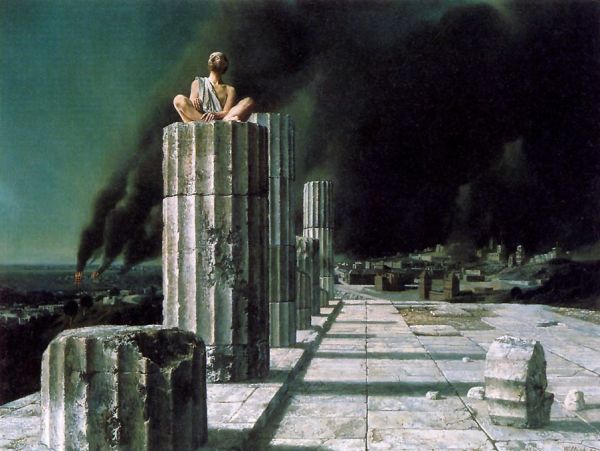
These are Hesayan asthetics who have dedicated themselves to the contemplation of, and communion with, the sky.  They have pledged themselves to live out the rest of their lives on top of a small platform high off the ground.

In some places they live on top of a tall pillar, 20' in the air, or even 50'.  They eat, sleep, and pray on a tiny platform about 3' in diameter.  Their chins are always tilted up, away from the base earth and towards the mysteries of the upper air.

However, the tradition platform for a stylite is in a covenant tree, which are tall and very strong.  There is usually a second platform lower down, where petitioners can kneel while they speak to the stylite.  Petitioners who fall off the covenant tree while climbing are assumed to have deserved it.


Stylites are fed by songbirds, who vomit in their mouths.  They drink rainwater, that collects on the trunk.  Although everyone agrees that their primary forms of nutrition are miraculous, stylites are also fed and watered by local villages.  It is both useful and honorable to host a stylite.

Stylites speak with the clouds.  They communicate through yoga, and the clouds communicate by changing shape.  Sometimes stylites hear messages that were carried a long distance on the wind.  Stylites always hear the Silent Bell of Saint Dorbaine, and inform their villages when they are called to secret masses.

It is said that stylites are capable of flight, since they are blessed.  It is also said that stylites choose not to fly, since they are humble.

One of the most famous Stylites is Jerannia the One-Armed, who is a frequent critic of the Pope.  The two of them often write letters to each other.  

The Order of Stylites is opposed by the Order of Precipites, the cliffjumpers.

from Simeon of the Desert by Luis Buñuel

How to Use Them in Your Game

Use them as sages.  They know all sorts of stuff from talking to the clouds, and what they don't know, they can learn.

They're also holy men, so be on your best behavior around them.  They'll probably ask you questions to verify your goodness and/or knowledge of scripture before they help you out.  

Or they'll ask for a sacrifice.  A whole cow, cooked and salted, along with some wineskins is a pretty considerable sacrifice.

Or go traditional; give out a quest.

by Carel Willink