Sunday, June 4, 2017

NO I FUCKING DON'T

This is a response to this.

I'm going to imitate an imitation that started when I made an suggestion about writing the opposites of monster manual entries.

I'M GOING TO PROVE THAT I DON'T FUCK PIGS BY WRITING THE SAME THING AS SCRAP.  I'M GOING TO WRITE SUCH GOOD ENTRIES THAT SHE'LL HAVE TO RETRACT HER ASSERTION RE: THE ALLEGED PIGFUCKERY.

Yes, this is a joke post but many of these are def usable.

by Dave Simons
So here are some monsters and their opposites.

Aerial Servant
Floor Lord 

Like a genius loci, they are bound to one place.  They look like enormous angry faces coming out of the ground.  They can cast command at-will, dominate person 3/day.  They use their powers to convince people to jump into their mouths, so they can eat them.  Usually accompanied by 1d3 enslaved humanoids from the wandering monster table.  HD 10, but easy to kill because you can probably just pour boiling oil into its mouth.

Ankheg
Stompadon

Looks like an elephant, only much bigger.  It has elephant heads on all four sides.  It rules the Plains of Yabin with a single immutable law: everything must be flat.  If something is not flat, it will be chased down and stomped until it is flat.

Except for birds.  It's okay with birds.

HD 10  Def leather  Stomp 2d8 + trample
Move elephant  Int Mor low

The Plains of Yabin are inhabited by clover farmers who have learned to lie very flat on the ground when the Stompadon might be looking in their direction.  Sometimes they attempt to build tunnels but they must be built very strong, because the Stompadon is always walking around and he has a very particular way of walking.

Giant Ant
Royal cannibals.

Already did this one.

Ape
Elves

Because apes are sort of like our hairy, brutish reflections and elves are sort of like our elegant, hairless reflections.

but

I can sort of see another angle, where apes are creepy because they're basically humans that look a little too bestial, but you could come at it from the other side and have animals that look a little too human.

So, there is a village called Husherman's Hill.  All of the animals that are born there are slightly too human.  The cats have hands, the cows have human mouths, and sometimes a dog will have a whole goddamn human face.

The animals run the town.  They are led by a old dog with a old man's face.  He is the most horrible bastard in the world.

When outsiders approach, the animals all try their best to be animals, and a few slave humans are brought out in order to shoo the foreigners away.  "You can spend the night in the inn, sure, but not any longer.  We're fearful you might bring the plague in."

Savvy players will realize that the town has been subtly modified for animal convenience.  An abundance of dog doors, cat scratches on all the baseboards, a dinner table in the barn instead of a feed trough, etc.

From Invasion of the Body Snatchers (1978)
great movie but fuck that dog-man-thing
Axe Beak
Sword Tongue

These are like if birds had a sloth edition.  Slow, aboreal.  Hunts food with a sharp tongue that they shoot out like a harpoon.  Can pull a man into a tree in the blink of an eye.

Baboon
The opposite of a baboon is a baboon.  They're already this terrible mix of clever and bestial, social and violent.  They have both thumbs and fangs.  They kidnap wild dog puppies and raise them to be loyal hounds.  You can watch videos of them playing with their babies and you can watch videos of them eating baby gazelles alive (who scream a lot).  Baboons are fucked.

Note to self: replace wolves on an encounter table with baboons at least once.

Badger
Goodbelly

A goodbelly is a thing that looks like a happy, baby pig with long legs like a deer.  Put it on your wandering monster table.  When it is encountered, it will run away.  If you can catch it and eat it while it is still alive, it will cure light wounds and remove disease.

They're slick little fuckers, though.

Baluchitherium
Strabulo Swarm

A strabulo is a small, carnivorous shrew.  The best way to kill a pack of them is to lock them in a small room and wait for them to eat themselves to death.  This takes about an hour.

It is unknown how they survive in the wild with such crazy metabolisms.

Barracuda
Zark

A zark is a zombie shark.  They are used to stock dungeons because they can chase people down hallways, in a horrible, clumsy, gnashing manner.

Also good for when the party thinks they are safe as long as they don't go in the shark tank, but then the wizard gives the signal and they all come flopping out of the water like ghastly seals, chewing their own gums to shreds with eagerness.

They probably roar, too.

Basilisk
Galateas

A galatea is a race of beautiful stone women.  It turns out that if you carve some stone to look sufficiently sexy, it will come to life.  Galateas are sexy living stone statues that really good at carving more of themselves.

Often hired to build beautiful structures, their immortality often leaves them as gloomy keepers of abandoned places, knowing all of the dungeon's layout but only caring for its statues.

BeaverBearBeetle
TreeMouseButterfly

Or as the elves call it, the Nirfling.  They're born from mice that eat discarded cocoons. Smaller than your thumb, they don't fly as much as they tumble their way through the air with their bushy whiskers.

Valued by elves for their ability to find candy and sweet breads, and their assistance in creating the same.

Valued by dungeoneers for their ability to pick locks.  However, after picking each lock, a Nirfling will crawl inside the lock and take a nap for 1 hour (part of their territorial habits).  It can be lured out early only with the offering of a fresh-baked cookie.

Beholder
Terophidian

Ha.  Already did this one, too.

Black Pudding
White Ceremites

A class of small ceramic golems.  They appear to be made out of soft white clay, but they harden upon death.  The resultant ceramic is about as hard as adamantine for a round, as hard as steel for a day, and then normal fired clay afterwards.

They can shatter their own heads at will in order to kill themselves into more useful shapes.  With enough of them, you can build pretty much anything.

A popular command: begin strangling someone and then self-destruct.

Another: grab your opponent's sword and belt and then self-destruct.

Blink Dog
Stare Cat

These are predatory cats.  When they hold your gaze, you are unable to let it go.  (Gaze attack: if you look at them while they are looking at you, you are unable to look away or willingly interpose an object for as long as the stare cat looks at you.)  They use this ability to give their fellow cats the ability to ambush you from behind (+1d6 damage).

They're about the size of a bobcat.  Stats as wolves, otherwise.

Boar
Excitemen

The Excitemen are are victims of a contagious excitement.  It is dangerous to be around them for too long, but you may be able to turn their considerable attention to something advantageous.

Despite their great excitement, the excitemen are not particular effective.

When killed they collapse into a rainbow-colored goo that lights up in the presence of sound, the color corresponding to the tone.

Brain Mole
Gun Worm

Originally bred by elves to be fired from their revolvers.  It's a 3' long worm, slightly spiraled.  It flies about 200' per round, and prefers to make fly-by attacks (bore-through attacks) each round.  It flies through walls and floors and flesh without slowing, leaving only holes to mark its passage.  In regular dungeon combat, it is so swift that it can only be hit with readied actions.

Brownies
Yeah, tickle boys for sure.

Buffalo
Chicken

Bugbear
Stronglings

A race of fey about the size of a child.  Obsessed with building and measuring their strength (which is easily estimated by the length of their beard).  Construct crude weightlifting gyms out in the forests, usually as simple as a row of stones of increasing weight, with a clear area around them.

In combat, they favor tactics that allow them to use their brute strength to their advantage: sudden, muscular assaults.

They are fond of forcing a surrender by putting their foes into submission holds, usually with their legs locked around the necks of their opponents.  (Then they can ride them around on their errands.)  If you have a strongling riding you, be aware that they can pop your head off with one squeeze of their monstrous calves.

From 2nd Ed Monster Manual.  By DiTerlizzi?
Bulette
Seawolf

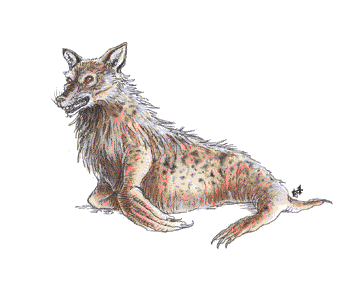
The opposite of a landshark is a seawolf.  Unfortunately.

or

Angelbird
When it smells blood, it flies over and tries to rescue the injured combatant who is the most innocent-looking.  It abducts them back to its nest and will keep them there for days, nursing them and keeping them safe from all threats (especially their dirty, blood covered companions who keep wanting to bring them into murder caves).

Despite its appearance, it is actually Fairy/Dragon type.

by DenaJawawr

BullCamel

Cow Egg

Occasionally, a cow will lay an egg.  We do not judge the cow harshly for this, for the resultant eggs are very valuable.

If kept warm and intact, the egg will whisper secrets into the ears of anyone who sleeps next to it.  (Get visions of likely future events with 75% accuracy.)

If broken, a random creature within 100' must save or die.

No one is quite sure how to get them to hatch.

Thursday, June 1, 2017

The Ranger and the Wandering Monster

I was sitting in a Burger King parking lot today and thinking about game design.  I have some thoughts.

1. My players don’t care much about encumbrance.  Being encumbered doesn’t seem to have many effects on the game.  They usually escape fights by locking doors, rather than outrunning their foe They don’t fall into bodies of water very often.  Those are things where encumbrance comes into play.

Basically, I’m still looking for a way to make encumbrance interesting.  (I mean, it's easy to make encumbrance important.  But interesting is another thing altogether.)

2. I want exploration to be the main focus of the GLOG.  And while “more rules about X” doesn’t always mean “more gameplay about X”, it’s worth putting some more thought into it.

Basically, I want to make dungeon crawling feel as interesting as combat.

3. Rangers are a tricky thing, conceptually.  There’s the survival expert thing, the animal companion thing, the nature magic thing, the archery + dual-wielding thing.  They’re all over the place.

Basically, I’m still trying to nail down the ranger-concept, and look for unique ways that they can contribute to the party.  I want each class to feel very unique.

by Cosimo Galluzzi
Noise and Perception

First, let’s redo the wandering monster roll.

Old Wandering Monster Check:
  • Roll a d6 every 30 minutes.
  • 1-2 = random encounter with monster or NPC.
  • 3-4 = clues to what’s on the wandering monster table.
  • 5-6 = nothing special.

New Wandering Monster Check:
  • Roll a d20 every 10 minutes.  (Basically every room.)
  • 1-2 = random encounter with a monster or NPC.
  • 3-4 = clues to what’s on the wandering monster table.
  • 5+ = nothing special.

This is fine, but it doesn’t do much.  It’s a little more chaotic (since you can now get two encounters immediately after one another) but the odds are basically the same.  Perhaps it’s easier to remember (since you’re rolling every room, instead of every 3 rooms) but it’s also more dice to roll.

So let’s get weird.

When you are dungeon crawling, your party has stats the same way that your characters have stats.

Two of the stats that your party has are called Noise and Perception.  The default party has Noise 2 and Perception 2.
  • Noise corresponds to how noticeable your party is being as they walk through the dungeon.  It correlates with rolling a 1-2 on the wandering monster check.  I.e. “You are noticed."
  • Perception corresponds to how well your party does at noticing the other folks who are walking through the dungeon.  It correlates with rolling a 3-4 on the wandering monster check.  I.e. “You notice other people.”

The following things modify your party stats.
  • Each encumbered character.  +1 Noise.
  • Each large animal traveling with the party.  +1 Noise.
  • Each ranger in the party.  +1 Perception

If a party has a donkey, an encumbered rogue, and a ranger, the party has Noise 4 and Perception 3.  The ranges of the two results on the wandering monster check should change to reflect that.  Ergo:
  • 1-4 = random encounter
  • 5-7 = notice other people
  • 8+ = nothing special.
by Cosimo Galluzzi
Ranger Abilities

Rangers can also track down the people that they notice.  If they want to find them, it takes 1d4(exploding) exploration turns, with each turn requiring you to move in a random direction to follow the trail.  If you find them, you have a 50% chance of surprising them.  If they have a lair here, there is a 50% chance you will find the lair instead of them.  If you find the lair, there is a 50% chance it will be empty.

So that’s an interesting niche, I think.  The ability to manipulate the wandering monster table is a powerful one (although not as exciting as a wizard’s fireball).  Probably more useful than a + to hit, though.

I’m also thinking about other ways rangers can manipulate random encounters.  Possible ideas:
  • Increased chance of terrain advantages.
  • Ability to avoid certain entries on the wandering monster table.  “I want to avoid whatever is leaving all these acid-smooth gouges in the stone.”
  • Ability to seek out certain entries on the wandering monster table.

A lot of almost-TPKs in my games have come from wandering monsters showing up when the party is severely weakened.  Depending on how far I turn the dial, I can imagine a ranger being more helpful for a party’s survival than a cleric.

I like the sound of that.  

by Cosimo Galluzzi

Wednesday, May 31, 2017

The Seven Souls of Shadoom

Shadoom was the ur-Sorcerer, the greatest villain that the world has ever faced.

His schemes were limitless, and his inventions beyond categorization.  His traps and manipulations were so subtly woven that we are only now figuring out their depth, 700 years later.

He was the first to capture the spell that went on to become Power Word: Kill.  He built the first wizard tower (intending to eventually ride it to space).  He invented the cackling monologue.

And then he was hunted down (many, many times) and killed.

Ever since the Yellowcoat incident, the Church has been aware that occasionally the dead and the damned do not stay in hell, but instead return to the living world at the head of an ungodly host of demons.  And so it was decided that Shadoom would not be allowed to descend to hell, although he deserved many infinities of suffering, but would instead be kept here, where the fragments of his soul could be contained and monitored.

I: The Mineral Soul

First there is the matter of the mineral soul, what you might think of as chemistry.  This soul stays with the body after death, maintaining the concept form and ensuring adequate nutrition for decomposition.  They are quiet and hardworking engines of natural laws.  It is the ghost-in-the-corpse.

Shadoom's physical soul is not like it's kin in other rotting bodies.  It seems to have a fierce desire for continuation, although very little means to achieve it.  Attempts to communicate with it are met with blasphemy and gibbering.

The corpse is growing.  Although Shadoom was much less than 6' in life, his corpse is now more than 8' tall.  Most of the growth has occurred in the rib cage.

The only type of growth that the mineral soul permits is a fungal.  His skin is buttery with yeast, and what remains of the head is almost entirely obscured by polypores.

It's not a body anymore.  It's a lair for the mineral soul.

There are many who believe that it is not a mineral soul at all.  They claim that it is something much stranger, something invited into the body at the behest of Shadoom (or perhaps inserted as a punishment or means of control).  While attempts to study it have stalled, many are hesitant to burn it,

studies have stalled as the spirit has frustrated their attempts at investigation.  Still, Lady Stravia is hesitant to have the body destroyed, since that may release whatever is holding it together.

II: The Vegetable Soul

Think of the second soul as "the laws of biology" and you won't be far off.

Shadoom's vegetable soul exists in the body of a young man named Tappernick, who is an exact physical clone of Shadoom.

He is the assitant gardener at the Minthic Priory is Kaskala.  He is short and swarthy and tanned from the sun.  His hands are rough with callouses.

He is unaware of his heritage.  All he knows is that the paladins always seem to enjoy dining with him when they pass through.  He doesn't know why, since he doesn't consider himself to be very interesting.  Nor does he understand why the paladins are sometimes tense in his presence, or else amused.  He's just a gardener.

He always tries to send the paladins off with a magnolia blossum.  Sometimes they accept.

The whole thing was Lady Stravia's idea, of course.

III: The Animal Soul

The third soul can be thought of as the instinctual soul.

Shadoom's animal soul is possessed by a incredibly unhappy young girl by the name of Ursiline.  After her second attempt to drown herself, she was entered into the convent of St. Rashene on her 17th birthday.

It is unclear how the girl found out that she possessed one seventh of Shadoom's soul, but she now dwells on it constantly.  She has written letters to Shadoom blaming him for her unhappiness.  She has written letters to Lady Stravia assigning blame for her "imprisonment".

Lady Stravia, for her part, has expressed regret about how the whole thing was handled.  She may end up removing Ursiline from the convent entirely.

Those are the first three souls.  For most people, they are reincarnated.  They are the earthly souls.

The remaining four souls are the heavenly souls.

IV: The Purple Soul Which is Memory

The fourth soul, the purple soul, is composed of memories.

Shadoom's memories were reborn into the child of a farmer.  The boy's name was Roflund, and he was fully aware of his past life since three months before his birth.

Roflund was born on a hot summer night in the second basement of the Lustrine Cathedral in Coramont.  Lady Stravia herself helped deliver the baby.  Her hands touched him before his mother's hands.

Also in attendance were 40 paladins and a priest-wizard.  Such caution ended up being unecessary, but there were many who were convinced that the fetus would be able to work some deviltry in the womb, and were therefore prepared for *anything* to come through that dilated cervix.

The newborn was also panicking.  Nothing in Shadoom's memories had prepared him for the nightmare of being born, that offensive tumult of noise and cold and fluid-filled lungs.

The attending paladins were not put at ease by the newborn's reassurances.  A wizard's vocubulary sounds bizarre enough coming from a wizard.  It sounds even stranger coming from a newborn at his mother's breast.

Roflund spent the first six months of his life being extensively interviewed by the Church.  (Claims of torture are unsubstantiated.)  Roflund proved to be much more helpful during interrogation than his soul's predecessor.  It was through Roflund that we learned of such things as the resurrection engine and the four-chambered mountain.

Unfortunately, Shadoom anticipated his capture and removed many of his memories in the days prior, entrusting them to certain lieutenants.  Some information, such as the location of the third apocalypse maggot or the fate of the princess of air, is still lost to us.

Roflund is now a paladin of the second rank in the service of the Lustrine Bishop.

V: The White Soul Which is Morality

The fifth soul is the white soul.  It embodies goals, values, ambition, and morality.

It belongs to a woman named Jetta of Harwater.  She is awaiting trial and execution after murdering her debtholder.  It is possible that this is not her first murder, but there is scant evidence.

Her trial has been delayed indefinitely, after Lady Stravia suggested it to the magistrate.

VII: The Red Soul Which is Personality

This is the personality of a person.  It contains their mannerisms and their perspective.  It controls (and is controlled by) their moods.  It is their emotions and their intellect.

The red soul is contained in Lady Stravia, the bishopess of the East Temple of the Shackled Flame, one part of the Church in charge of ensuring that old troubles do not rise again.  They have more historians in their ranks than paladins.

The discovery of the identity of Lady Stravia's red soul occurred when she touched Roflund during his birth.  As soon as it occurred, she was imprisoned and interviewed extensively.  She was released nine months later, at the command of the Eastern Pope.

She has since been reassigned to minister the penitent's commune in Guilder.  It is said that their farms have never been so productive.

VII: The Blue Soul Which is Divine

Of Shadoom's blue soul, little is known.  The blue soul is the seat of the spirit, the divine conduit, and the magical tongue by which the mind speaks.

In theory, this is the most perilous of Shadoom's souls, since it contains all of his arcane puissance.  And yet, no recent sign of it has emerged.

It is possible that it has eluded capture by avoiding reincarnation.  If so, it has managed to trickle down the the anonymous chaos of the hells.

Or it is possible that it dwells in a simpleton, who has neither the intellect to comprehend the power the possess, nor the will to wield it.

And it is even possible that Shadoom's blue soul eventually outgrew Shadoom himself.  A man cannot dominate the world with so much power without being dominated by it in turn.  If this is the case, then Shadoom's blue soul lives on without him.  It will be mindless only until it certain arcane furcations occur (and they must occur, or else it will be eaten by the creatures of the upper air) until it becomes its own creature, seven-souled and independent.

And if that is the case, the six new souls will themselves be cast-offs, the flotsam of identity, survivors of some other personal extinction.

Nothing is destroyed, nor anything created, except by the Hand of the Authority.

Monday, May 8, 2017

Beyonders (+ Some Astral Sailing Stuff)


Space, as you think of it, is composed of two main parts.

There is the Astral Sea, in which all of the planets and solar systems are embedded.  (Light from the Astral "water" doesn't penetrate the ozone layer, but as soon as you leave the planet, you'll see it shining in all its glory, like an ocean of thin, pearlescent mucus.)  Picture a universe filled with thick spiderwebs, and then sailing across the surface of those spiderwebs as if you were a very tiny ship.

<digression>It's not hard for mid-level characters to sail into space.  Here are some possibilities:

  • Equip your ship with both a stormsail mage (collect and shape enough rain as it's falling and you can sail into the sky) and the proper astral sails and you're set.
  • Go to Ba Dwai La, where you can walk to the moon.  Buy a ship and launch yourself off the Last Waterfall, into the Astral Sea.
  • Climb the Cat's Tail to the moon, when it passes overhead.  Buy a ship and launch yourself off the Last Waterfall, into the Astral Sea.
  • Sail to one of the poles, and sail up the chalaza--the twisted string of an ocean that connects the planet to the Astral Sea and the solar system.
Hell, you could do any one of those things before level 3.</digression>

Then there is the Beyond.  It is everything else.

In practice, this means the parts of space that are very far away from the surface of the Astral Sea.  Away from the egg stars and the light-hives.  Nowhere near the mirrored pillars of creation.  Away from the beaconed sea-highway that leads to the Seat of the Authority himself.

There are dead planets.  Cold places where no light has ever shined.

There are the tessuract-ships of liches, who have finally found the peace and quite they could never get on Centerra itself.  Tomb-cities buried deep beneath the crust.

There are elf-seeds.  Impenetrable spheres of runed adamantine, carrying the belongings of some elf lord forward a billion years into his kingdom at the end of time.  They will survive the heat death of the universe, when the elves will return to claim them.  Time machines traveling one hour per hour.  Just fancy luggage, really.

And then there are the creatures that were born out here.  These are the beyonders.

There are many kinds of beyonders, of course.  These are just the ones that are encountered most often in dungeons.

The Beyonders

It is rumored that they are related to the organic satellite-people that orbit Centerra (although the planet is more accurately called Phosma) but this is probably untrue.

Out in the beyond, they look like large hula hoops of flesh and organs.  They're about 60' in diameter.

But your players will probably never encounter them in their native state.  They'll probably encounter them because they rolled a random encounter on dungeon level 6.

So how does a fleshy hoop explore a dungeon?

They do so by creating a portal.

The portal is shaped like a human.  A round, innocuous bubble-shaped human.

They can seal the skin of this portal with something akin to glass.  Which is good, because otherwise they'd just be human-sized holes in space, sucking in crap from all over the dungeon and blasting it into empty space, where some of it would presumably collide with the Beyonder.

When they are walking around a dungeon, they look like a man inside a bubble-suit.  Opaque and dully reflective.

like this, except less shit
At will, they can open up part of their body as a portal and suck stuff in.

They can open up their hand to suck in a coin, and close it smoothly behind it.

If they open up their chest, they can suck in things as large as a human.

They have to be careful with this tactic, though, because anything that gets sucked through is also being shot at their own body, which is a fleshy hula hoop encircling this portal.

They have some telekinesis.  They use this to catch stuff (coins, weapons) and pass them back outside the portal to their bubble-body as they are needed.

Beyonder Bubble Skin
HD 4  AC plate  Space Mace 1d6+1d6 cold
Move as human  Int 10  Mor 4

Immune to non-magical slashing and piercing.

Summon Skin -- Create or remove the glass-like bubble skin that covers the body-shaped portal.  Usually only has a certain patch open at any given time.  Free action.

Portal -- Unless there is bubble skin covering the portal-body beneath, the Beyonder sucks stuff in like a tornado.  5' away = Str check with a -4 penalty.  25' away = Str check.  No effect beyond 30'.  Once you get sucked up, you get a second chance to catch yourself if there is something between you and the Beyonder that you could potentially grab onto.  And yes, if you get sucked through the portal, you can remain conscious for one round while you stab the Beyonder's flesh-body in its stupid flesh-face.

At-will spells:

  • telekinesis
  • teleport up to 10', disappears on one turn, reappears on the next turn. (this is just the Beyonder closing the portal, and reopening it nearby.)

If the bubble skin is broken (or if the Beyonder turns it off), the Beyonder isn't defeated, but it is probably getting smacked in the face by all the stuff that's being sucked through.  Getting bathed in cold air is extremely unpleasant, and most Beyonders won't endure it for more than a couple of turns at a time.

If the bubble skin is broken they can regrow a new one tomorrow.

Beyonder Corpus (the hoop of flesh in space)
HD 2  AC plate  Attacks none
Move *  Int 10  Mor 4

Even if the bubble skin is broken, it isn't immediately obvious that there is a ring of flesh 30' into the portal.  The easiest way to discover this is probably to throw a torch through.

Beyonders aren't stupid, and as soon as they realize their foe has figured out how to damage them, they'll withdraw (which is as simple as closing the portal).  They'll probably come back later.

By the way, they can't teleport their bubble-skin body all over the planet. Whenever they re-open their personal portal, they can only re-open it in the same location where they closed it last time (or at least, within 10' of that point).  This means you can imprison one, as long as the walls are at least 10' thick.

Each Beyonder also keeps 1d3-1 things on hand that they can throw back out their bodies in case things get desperate.

Holdout Weapons [d6]
1. Just a big brick of chlorine.  Quickly evaporates into a gas upon hitting our atmosphere.  As acid cloud.
2. 2d6 legless ghouls.  (Space is full of ancient, insane ghouls.  They're about as common as hailstorms.  Most cut off the unnecessary bits and throw them in order to gain some momentum in space.)
3. Captured light from a dead star.  3d6 necrotic damage, 100000000' cone, save for half.
4. A jet of dust going 400 miles per hour.  Functions as a 30' line of piercing damage that does 3d6 piercing damage each round for up to 3 rounds (as long as the Beyonder concentrates).  Half damage if you succeed on an Armor save.  (Roll your AC like a save.)
5. A lump of lead the size of a VW bug.  Treat this as a melee attack roll (it can't throw the lump very far) with a -4 penalty (it's not very accurate) that does 3d6 damage and pins its target.  The lump is so cold that it sucks the heat out of the room, dealing 1 cold damage on each each subsequent turn for an hour.  Ice will form after 1 minute.
6. A domesticated florgurg.  Just tentacles and teeth.  Sings like a whale being sucked down a garbage disposal.  HD 3  AC leather  Grab/Grab/Bite 1d12.

Monday, May 1, 2017

Wombs and Witch Kites

Crows are the favored pets of witches, and so their kites are made primarily from crows.  They are sometimes confused with smirches (dire crows).

This doesn't have to be the case, of course.  It is said that a witch can make a kite from any flying thing, as long as it loved her and no other.

It is a common misconception to think that they are undead, or that they are somehow mindless.  Although they seem ghastly and otherworldly, they are flesh and blood.

They are only ever constructed by witches, because witches have wombs.


Witches and Wombs

A man cannot be a witch, because he does not have a uterus.  

<digression>There are, of course, exceptions.  

The generative process (the second, vegetable soul) has produced every conceivable arrangement of the sexual organs.  There are rumors of boys born with internal wombs.  And of course, phenotyphical men have gained wombs from certain ecliptic rituals, or from their patrons.</digression>

The Church teaches that while the vagina is sexual, the uterus is spiritual.  After all, it is the womb that receives the soul that is sent by Zulin to populate the body of the developing embryo.  

However you explain it, the uterus is doing an impressive feat: growing and differentiating tissues while simultaneously installing the remaining 5 souls, each installation occurring approximately two months apart.

<digression>This is not how eggs work, which explains their very different properties.</digression>

<digression>Growth, by itself, it not impressive.  Even stones will grow at the proper confluence of leylines, and they only have the first soul--the mineral soul.  This is where mountain ranges come from.  See also: Round Mountain.</digression>

The part of the uterus that collects the incipient soul is called the perimetrium.  This is why different sexual positions can affect the nature of the resultant creature--different positions affect the sacred geometry of the perimetrium, which likewise affects the characteristics of the souls it is able to attract (or retain).

For example, it is known that those conceived in the rear mount position are predisposed towards shamelessness, vandalism, and scurvy.  This is why the Church discourages it.

There is even the chance of entrapping 'souls' that are not human souls at all, and are incompatible with the other souls and tissues.  These are spirits, demons, angels, and all the sundry pseudofauna of the ethereal plane.  Accidental incorporation is the prime cause of stillbirths and birth defects, and it is why such things are quickly burned and buried.

More than any of the body's organs--except for the brain--the uterus touches on the ethereal plane.

A uterus is an immensely powerful tool in the hands of a witch.  Like all tools, it can be turned from its original purpose (receiving godly souls sent by Zulin) and towards darker intentions.  It can be a net used to capture spirits.  It can be a sieve to sift through them.  It can even be a garrote, or a scalpel.

This is why so many hags and witches choose to grow larger: more room for more uteruses.  The witches that are most successful at this endeavor are able to achieve thousands of conceptions in their lifetimes, and hundreds of births.  Souls and newborns are powerful currency to witches.

And that is why you will often find hundreds of infant skeletons beneath the floorboards of a witch's house.  

not a witch kite, but cool anyway
from the Space Cowboy
Witch Kites

They were crows before their consumption and second birth.  Now they are something else.  They've been shuffled.  A little less crow, a little more human, a little something else the crept in around the edges, like a tree root into a cracked pipe.

They look like four-winged crows with large amounts of black hair woven into their feathers.  Crows with weaves.  Their wings are long and finely articulated--feathers can be individually shifted.  A normal crow can move its wing the way a human moves their foot, a witch kite can move its wings like a human moves their hands.

They have no legs, and so they cling to the sides of trees with their tiny talons, or hang upside down from ceilings.  

Their wings do not touch the air.  Instead they fly by shifting their wings to catch different etheric (intangible) currents.  It's similar to how a ship angles its sails to catch the wind, except in this case there are multiple, overlapping, non-interfering winds.

It looks a bit like a four-winged bird rapidly alternating between yoga poses.  If you were to catch one and pluck it, you would find nothing except feathers, more feathers, and bones (not all from the same bird).

And each pose catches a different etheric wind, throwing the bird in another direction, or with a different type of angular acceleration.  Open all four wings wide, face vertical, and the bird can hover.  They don't travel fast, but no other flyer can change direction as fast as them.

They do not eat, and instead sustain themselves by watching meat decay.  The larger the decay, the faster they are fed by watching it.  

A day's worth of sustenance might be gained by watching an elephant rot for 10 minutes, or a full 8 hours of a weasel slowly bloating in the sun.

Witch Kite
HD 1  AC chain  Atk none
Move as hawk  Int 6  Mor 6

Shadow -- When a witch kite's shadow passes over you, you take damage at the end of the witch kite's next turn.  The damage manifests as scratches on your most vulnerable body parts, as if delivered by an enormous crow's talons.  The amount of damage depends on the light.

Sunlight: 1d6 non-lethal
New moon: 0 damage
Partial moon: 1d6 lethal
Full moon: 1d10 lethal

Suicidal Impulses -- If a witch kite flies under a creature's legs, that creature must save or attempt to kill itself as quickly as possible.  This usually takes two rounds (one round to fuck yourself up, and another to finish the job) unless that person isn't carrying weapons for some reason.  A person gets a save at the start of each round (beyond the first) to end the effect.  An animal (or someone with animal-level intelligence) gets a save at the start of each hour, instead.

Tactics: Witch kites like to fly higher than arrow range.  They like to use their suicidal impulse ability against a party's animals (since donkeys don't get to make attacks of opportunity).

Treasure

Witch Kite Cloak
When flared, this cloak launches you upward at 50' per round.  It offers no protection against falling.

Adamantine Ouroboros Necklace
This 5' length of steel chain is as thin as a piece of string.  There is a carved serpent head at each end.  When the two heads are brought together, they bite each other's jaws and lock together.  They cannot be separated except by thing capable of breaking adamantine.  One command word causes the jaws to unlock.  Another command word causes the necklace to each itself, severing whatever it is attached to and causing itself to disappear.