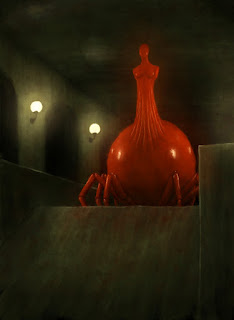
You start looting the body. Sixteen silver and a bag of marbles. You start to roll him over but suddenly the corpse’s jaw cracks wide as something pushes its way out of his mouth, plops onto the floor, and slithers away into the shadows, as fast as a rat.
It looked like a fat, silver tongue, studded with black beads. You hold your torch closer, start to take a look inside the guy’s mouth, and then decide better of it. It’s time to leave the dungeon.
Hey, I’ve never done a trigger warning before but let’s give it a shot: body horror, sexual assault, existentialism.
Brainworms
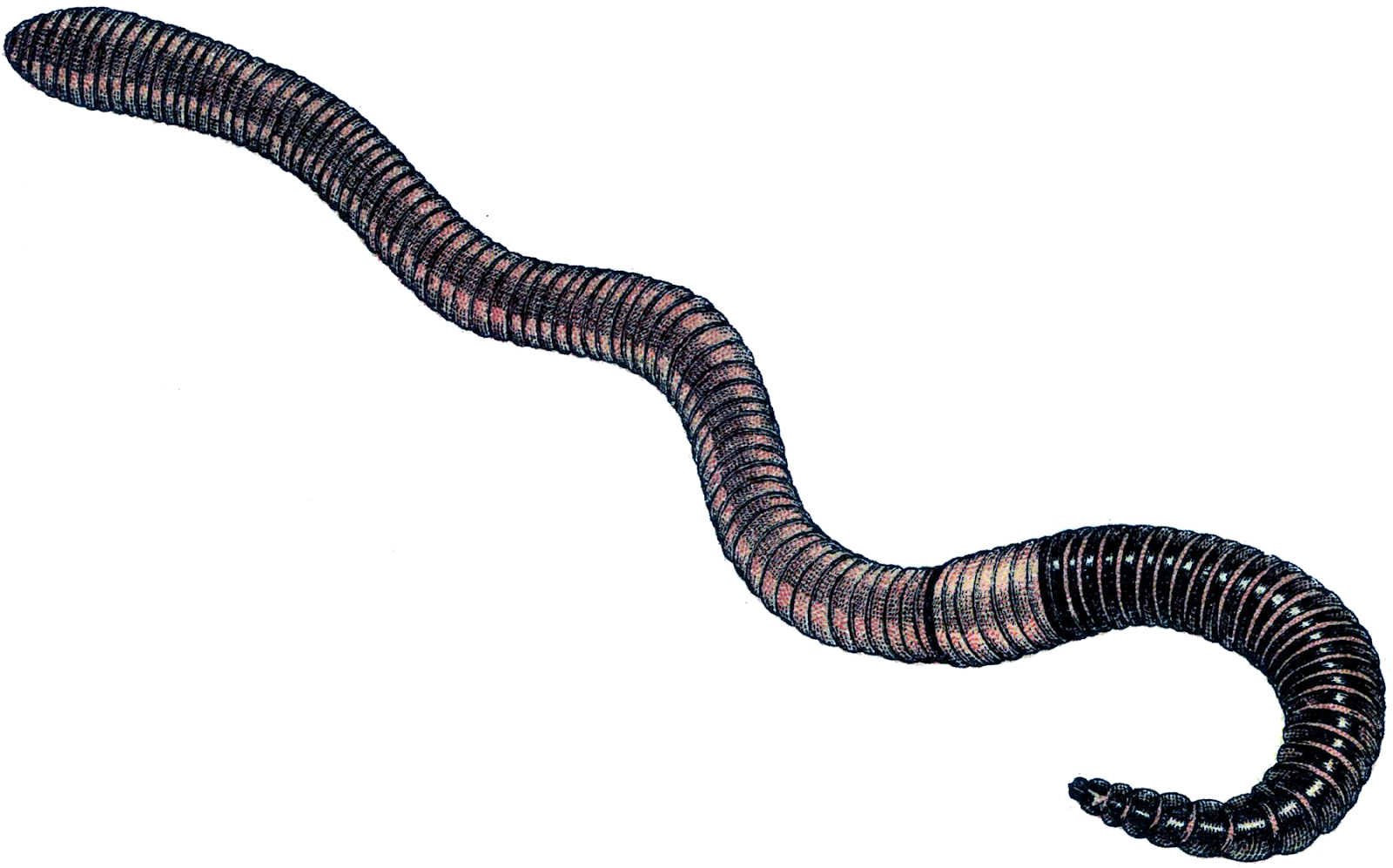
They’re slick little worms that crawl up your mouth and take over your brain. You’ve seen this before in other fiction. Animorphs was good. Slither was great.
But Centerran brain worms. These brain worms, once they start puppeting you, they inherit everything. Your nervous system, your memories, and–importantly–your sense of self. Your brain worm literally believes that it is you.
The worm memories are half-forgotten. I mean, you remember being a worm, and crawling up your own mouth, and how you had to do it. But mostly you remember the job that you need to get to on Monday. You start thinking about how you’ll tell your wife. You have a worm in your brain now, it seems. Will she be angry?
You start thinking about going to a doctor about it, but the idea nauseates you. It sounds painful. Ugh.
Because you’re dead at this point. Proper dead. Your brain has been eaten by the worm. There is nothing left of you. The person that is thinking all of these thoughts is the worm, who thinks that it’s you.
Are you still you? You still have the same favorite sports team. Worms don’t have favorite sports teams. Are you the worm? Or are you the man?
There’s a philosophical debate here but you don’t care. Phineas Gage took a spike to the brain and his whole personality changed, but people still called him by the same name. Whatever has happened to you is a lot less dramatic than that.
You unlock the door and walk into your house, bumping your shin on the same coffee table that you always do. You drink a cup of water. It always tasted like this, a little metallic but not bad. Then you open up the door to your bedroom, lift up the sheets, and lie down beside your wife.
As you fall asleep, you decide that you won’t tell her about it. Wouldn’t be the first secret you’ve kept from her.
As the days go on, you realize that you’re not quite as coordinated as you used to be. Maybe there’s a lag in the brain-worm connection.
But if you tie your shoes a little slower, no one seems to mind. Your dart game has gotten noticeably worse, but the boys at the pub honestly seem happy about that. Your wife notices though, and urges you to go to the doctor.
I’m fine. I don’t know. I’m just getting a little older.
Can you forget that you’re a worm now? Almost. Not quite. Not really.
Back when you were a full human, the darkling minutes between wakefulness and sleep sometimes brought strange thoughts and half-dreams. But falling asleep is different now.
It seemed a nightmare. You were curled up so tight against yourself. Your mouth was a matrix of prickles, and your limbs were nowhere at all. At your center was a very complicated thing, but you had opened it up and softly probed inside it. You had many tongues and you could taste all the different sides of it. And then you realized where you were and you woke up. Or, wait–that’s not right. You were already awake. You just panicked and clamped down on the very complicated thing, and then you were back in your bed again.
It happens a lot as you fall asleep. As you relax, you tend to come untethered. But it’s not a bad thing. There’s a lot of privacy inside your own head. A little room of your own. You go to bed twice now. Once in your blankets and once again in your skull.
The thought doesn’t seem alien anymore. Like a second puberty, you suppose.
There’s advantages. You can learn to selectively detach. You can turn your senses off, one by one, if you wish. There’s been at least one time when you had to stifle a smile, while the priest’s mouth moved in a pantomime of a lecture, but in perfect silence. He didn’t know how silly he looked.
Then came a strange time. Small feelings of nausea and vertigo. A persistent feeling of fullness. And then you realized that you weren’t alone inside your skull anymore. There was another one.
You were a parent, you realized. There was another little worm. A sleepy thing, with simple thoughts. You could feel their intentions pressing up against you. The little worm had no deep thoughts. Just affection towards you. It huddled up against you, a psychic infant curled up against you, trying to keep warm.
You tried to think positive thoughts about it. You certainly felt positively about the little worm. Poor little guy. Barely knows what’s going on. How do I take care of it? You go to the market and look around for something healthy to eat.
But the feeling of pressure continues to increase. Week by week, the little worm is getting less little.
You only worry about it for a day before you figure it out. You were in the bedroom with your wife when the idea came to you. You grabbed her by the waist like you used to, pulled her against your body like you used to. You leaned over the bed and kissed her, and during the long communion of the kiss, you pushed into her mouth. The pressure released.
Afterwards, sitting in the kitchen, you justified it by saying that it wasn’t a bad thing. The same thing had happened to you, and you were perfectly normal afterwards. You’re not a bad person. You’re a nice guy. You just got carried away.
Your wife was actually a huge comfort.
“No, it’s fine. I’m fine. See?”
“The only thing I’m angry about is that you didn’t tell me when it first happened to you.”
“If you had told me, I would have let you do it to me.”
“Sorry about the blood.”
She had to pause the conversation several times. The amount of blood coming out of her nose was tremendous, and the bedsheet was soaked. She was standing in the bathtub, holding the sheet while the blood dripped fatly to the ground.
“It’s okay, honey. I love you.”
There was another philosophical discussion to be had here. Was she now his offspring, on some level? They both thought about it. She could certainly remember the days they shared inside your skull. But the concept was uncomfortable, and neither of you had the vocabulary for it, and so you talked about the best way to get the blood out of a bedsheet.
“Soak it in cold water. Are you crazy?”
Over the next few days, you realized that you could sense when your wife was coming home. When you were in the kitchen, you knew the exact moment when she woke up. And when you looked in her eyes you could almost see what she was thinking. Almost.
With practice, the two of you could sense each other across town. It was a comfort. You could close your eyes, and reach out and feel her off to the east. She must be visiting her sister.
These were happy days. You felt closer than ever.
And then one day you reached out and felt four. You recognized your wife. She had felt them too, and she was coming home. She was scared. She could feel you, too. She could feel how scared you were.
Back in the kitchen, sitting across from each other, panic coiling in your bellies. You were fools. You should have used this time to research. Asked a scholar. Asked someone.
Because now the three were getting closer. They were walking, but they were walking in a straight line. They knew exactly where you were, because they could feel you, too. Beside you, your wife sat quietly, her back straight as a rod. You could feel her terror impaling her like a not blade.
Of the three, you could feel nothing. Excitement, maybe. Something akin to hunger. And some other emotion you had never felt before.
But you didn’t have time to wonder about it. You could hear heavy boots on your step, and then a knocking on your door.
“Don’t open it.”
She sat hunched, staring blankly on the door.
As you opened the door, she started saying something else, but you didn’t hear it.
Mechanics
An individual brain worm moves as fast as a rat. They can only parasitize you if you’re helpless. If you are surprised by someone shoving a brainworm down your mouth while you’re making out with them, you get a Str check to resist. If one tries to sneak in your mouth while you’re asleep, you need to fail on an Int check and a Str check to be effectively parasitized.
Once it’s inside you, you have 1 round to do something drastic. Maybe if a quick-thinking wizard blasts you and the worm with a sleep spell, the worm can be safely extracted at this point.
In round 2, it eats your brain. You die. There’s a lot of blood. Happily, you can play as the worm now. The worm is just like you except that you get -1 Dex. You get +1 to a random mental stat and -1 to random mental stat (which may cancel out). You’re a vermiger now.
As a worm, there’s a few changes.
First, your movement is a little jerkier. It’s not obvious, but someone who is watching you closely might notice it. And if someone is specifically watching for vermigers, they might recognize you for what you are. However, the only way to know for sure if someone is a vermiger is to crack open their head and take a look. Keep a shovel handy, in case a worm makes a run for it. And keep a lawyer handy, in case a worm doesn’t.
Second, you’re gonna give birth to a little worm, and it’s gonna live inside your skull with you. You have some time to figure out what to do with it, but the big day is coming soon.
During those months of cohabitation, you’ve been building a deep emotional bond. A regular child is half of you, this child is 100% you. It only has simple worm thoughts, but it cares about you, at least as much as your dog does. You love it. You have no other choice.
So you can kill it if you wish, but it’s gonna be hard. You know that the little worm would fight to protect you. Little Worm wouldn’t give up on you. Little Worm wouldn’t crush you under a boot. If the tables were flipped, Little Worm would give everything to take care of you.
I don’t know what kind of rules you have for stress or insanity in your game, but killing Little Worm is at least as traumatic as killing your favorite 2 year old child. Save vs emotional damage and “I gotta go be an NPC for a session while I rethink my life.”
You can leave Little Worm on his own, but it’s probably going to die unless it finds a host. And the whole time that Little Worm is out there crawling around in the garden, cold and scared, you’re going to feel him. You’re going to feel him asking you for help. And then you’re going to feel him die.
You could also try to implant Little Worm in an animal. This is a bad idea. You know this, and so does Little Worm. This is innate knowledge, part of the collective worm unconscious.
If you implant Little Worm in an animal, he won’t grow up right. He’ll be a brute. He was meant to parasitize a person, not an animal. The connection will be bad. He’ll suffer from seizures and dementia from day one.
And there’s another risk, although you might not think about it at first. When a little worm grows inside Little Worm, he’s not going to have the knowledge or the willpower to show any discretion. Your grandbaby is going to go in the first person that Little Worm gets alone.
Your grandson will not be a good person. He didn’t grow up in a good skull, with a father who loved him and felt protective over him. He is going to be twisted by this in ways you won’t understand.
If you implant Little Worm in a person, they’ll go through the same thing you went through. They’ll be a bond between you. You’ll be able to read each other’s emotions, and sense each other up to a mile away.
And when you meet other vermigers, you’ll be able to sense them in the same way.
So those are your options.
Refugees
Some vermigers reject the call. They never open the door. They flee from everyone who seeks them: the Twice-Crowned Knights, the Fingermen of Farthest Madoola, and the witch hunters.
Of their three pursuers, witch-hunters are the most persistent, and the most dangerous.
The most common variant of this story is this: someone becomes infected. They infect their family. They are noticed, because one person with jerky movements can be hidden, but when a whole family suddenly develops tremors, it raises suspicion, and the Church’s witch-hunters are exactly the type of people to be trained in the recognition of these things.
Why do they so often infect the family? Because the instinct to implant a worm in another person seems to be strongly associated with feelings of love, affection, or trust. Similar to how love and lust are entangled, or perhaps boredom and hunger. We don’t have a similar word for the implantation-instinct, but its bells have their own ropes.
Why does love incite the implantation-urge? Scholars reason that this is part of the worm’s instincts. When a friend is parasitized in this way, the two people tend to bond over it. They share a secret now, and a connection. They are less likely to tell others, and they will risk more to protect each other. In this way the worm’s bloodline is secured against our own.
And so this is the first class of vermigers. Even if they are not discovered, they must keep a low profile, or they will be discovered soon. (This is another common class of vermigers–those unhappy corpses with their jaws held shut by wires.)
But often they flee before suspicion rises too high. They are refugees, or pilgrims, or perhaps just desperate merchants in an unlikely place.
Twice-Crowned Knights
It’s difficult to imagine, living as we are in our modern society where you can go bankrupt on Hawk Tuah cryptocurrency, but religion played a much greater part of medieval life than it does now.
Everyone was religious, in a small or large fashion.
Most vermigers, when they wake up with a worm in their skull, are still religious. They still believe that the world is just, and that the Authority watches over them, and that they will go to Heaven if they live a virtuous life.
They do not burn when they go to Church. They are not demons.
And so this transformation must be something else entirely. It’s not negative. In fact, it even seems to be a good transformation. Who wouldn’t want to empathize more with their neighbor? A community full of brain worms would be a community of empathy and fellowship.
So, the worms must not be a bad thing. They must be a good thing. They must be something that was meant to happen. Maybe not just to us, but to everyone. This must be part of the natural human cycle, the second half of our maturation. The worms are good and right.
Also tangled in the history of the Twice-crowned knights is a prophet, a charismatic preacher, and an isolated town in the mountains. All condemned now for the blackest heresy.
They are brain worm paladins, and here are some of the things they believe.
People who die wormless will be given a worm in heaven. An angel-worm.
It’s sinful to actively avoid getting a worm when you have an opportunity to.
It’s their duty to offer–but not force–other people a brain worm.
The Authority has a brain worm. (No creature is complete without one.)
Your ancestors come back as humans, allowing you to parasitize them.
Your ancestors come back as worms, allowing you to become complete.
Soulmates. Every human has a worm out there somewhere, and vice versa.
The worm has been completely integrated into Hesayan theosophy. They even have a fun creation myth of their own.
They absolutely see themselves as the good guys. They would never, ever force a brain worm on someone, but at the same time, it’s obviously a sin to turn it down.
It’s very analogous to conversion. It’s also a sin to force someone to convert. And no good guy would ever force someone else to convert, right?
You might meet the knights in your journeys, but you won’t find the secret villages that support them. The knights are interested in (1) recruitment, (2) rescuing refugee vermigers, and (3) fighting the Fingermen of Farthest Madoola.
In combat, Twice-Crowned Knights have all the usual benefits of a psychic link. Additionally, they all share HP.
A few of the Twice-Crowned Knights have even refined their abilities to a keener edge, and are able to broadcast emotions as a weapon. This is most commonly fear, but other emotions are possible. But of course, the Knights are not as proficient in this art as the schools in Farthest Madoola.
The Fingermen of Farthest Madoola
There is a city on the other side of the Madlands. It is called Farthest Madoola, but the name is mostly traditional now. The other, more famous Madoola fell into the Phantom Zone generations ago. Farthest Madoola only retains the appellation as a prophylactic against dimensional terrorism.
But none of that really matters. When the Fingermen arrive, they won’t tell you where they’re from, or about their fucked up social structure. You don’t need to know about the Glory Pits of Shambryllos, or the crowds that gather reluctantly inside the Procession of the Blood. The creature beneath the Academy Vault matters even less, so let’s not speak of them.
Fingermen do not believe in the continuation of the soul. They do not think that they are the host. They know themselves to be the worm inside–a killer and a master. The memories of one’s human life are just chaff to be pushed aside (albeit with no small amount of trauma).
The Fingermen are here to steal new stock for their millennial breeding program, and to reclaim the Seven Spells of Sealing, which were stolen from them so long ago. However, the fact that they sometimes find small naive clusters of vermigers here is just a lucky occurrence.
They are assassins, manipulators, and psychics. But what sets them apart is their mastery of brain surgery. They can add, subtract, distort, and rewrite–although the last one is the most difficult. It takes them a long while.
Adult brain worms cannot take over a new body. They grow to match one set of neurons, and only one. (Neuroplasticity goes both ways.) Nor can they leave their host without the host dying. But they can remove the top of a man’s skull, sit him on a chair, and then carefully stretch their body out of their host’s mouth. Then, with their own sensitive hyper-radulas, lick their patient’s brain into whatever shape they wish.
If they do a good job, the effect is indistinguishable except for the heavy scarring along the circumference of the skull. They are proud of their work, and the best work is when the new person never questions their false memories, and goes out into the world unawares, ready to assassinate the duke as soon as they hear the trigger word.
The other thing that makes them scary is that they often travel with Exiles.
The Exiles
If you’re paying attention, you’ll notice that there’s one stage of the life cycle that has not yet been discussed.
What happened to the brave worm in the second paragraph, who fled his cozy skull after the untimely death of his host?
An unpleasant fate awaits him.
Mature (post-implantation) brain worms are unable to re-parasitize a new host. Most will starve and die, all while possessing the same mind, believing themselves human still.
And yet, they are blood drinkers. They can subsist on flesh, although they have not the speed or strength to prey on anything. Sometimes they get assistance from the other Fingermen. Sometimes they are developed enough to send sleep over a rabbit before they crawl up and slide their prolapsed jaw over the rabbit’s head. Without the need to control a second body, their mental abilities tend to develop faster at this stage. They also delight in eating hot brains, fresh from the skull. (This is a trait that they share with fingermen.)
Most vermigers kill these things. These worms that flee their bodies. They are called exiles, and they are reviled as beasts, for beasts they are. Refugees, Twice-crowned Knights, and witch-hunters are all united in their loathing for these things.
But Fingermen cultivate these things, and refer to them as Elders. It is the natural end of one’s life cycle, they believe. Procreation is no longer possible, but one can still be a leader and a guide to one’s own family.
Similar to the mythical ability of the mundane goldfish, brain worms will grow to the size of their container. And without a skull to confine them, they can grow very large indeed.
Discussion
This post was once 1/10th the size and attached to the bottom of my last dungeon merchants post. However recent political events and Patrick’s excellent post (Softheads) have motivated me to tighten down the grape press and produce this.
Brain worms and mind flayers are old, beloved tropes and this is my attempt to put a new spin on them. Yes, it’s spooky when a squid man grabs your head and chews through it, but have you considered how spooky it is when (1) there’s a bunch of wizards who want to eat your brain and they only have a handsaw, and (2) there’s a giant worm that also wants to eat your brain, and it’s able to telekinetically pick you up and open your head like a soup can?