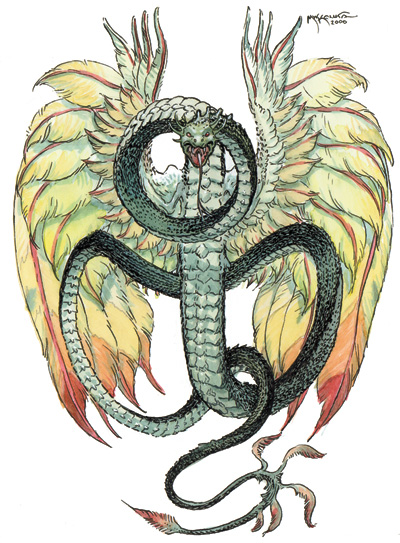
Saturday, October 31, 2015

Outsiders: Memes, Prions, and Dreadful Comprehension

Demons are not "outsiders".  How can they be, when they are part and parcel of the natural ecology of our souls?  The whole concept is stupid.  If anything, demons and angels are insiders--they can see us better than we can, in many ways.

Outsiders are things from beyond the universe.  They might occupy matter, but they are not made of matter.  Like light refracting through a prism.

There are many types of outsiders.  This is one of them.

The Unspeakables

They must not be spoken of, nor described in any way.

A picture of an Unspeakable is just as dangerous as one of the Unspeakables themselves.  The same is true of an appropriately accurate description.

This is because they are not creatures of flesh and blood.  They are concepts--lattices of convergent memes.  Although they sometimes occupy a body, they are not that body.  Though they are sentient, they are not alive in any sense of the word.  Even someone who conceives of them--without ever having seen one--is subject to this peril.

Skip This Section If You Already Know About Prions

There are proteins called prions.  Prions are not alive.  They are even less alive than viruses are (which are, at a minimum, just a string of DNA).  Prions are just a single, lumpen molecule.

Prions are misfolded proteins.  In your body, there is a certain type of protein.  This protein floats around, doing protein stuff, and no one has to worry about it.  

But occasionally this protein misfolds.  It gets jammed into the wrong configuration--some hinge is bent backwards, some spiral is spinning the wrong way.  The protein doesn't do the job it was built to do.  Instead, it bumps into other healthy proteins (of the exact same type) and causes them to misfold, too.

It's a little bit like packing a cubic apple in a crate with other apples, so that the neighboring apples come out with flat sides.  Except we need to extend the apple metaphor, so that when you unpack the crate of apples, they're all cubic.  One bad apple has bent the whole bunch.

So this isn't contagion in any sense that we know it.  It's a contagion of form, caused by blunt collision.  

The funny thing is, the misfolded protein is more stable than the original protein, not less.  Good proteins get bent into this hell-pretzel and they don't untwist.  They just float around, tempting other good Catholic proteins into temptation.  

This progresses.

The body notices that it is running out of healthy proteins, and so it makes some more to counter the deficit.  

This progresses more.

Eventually, there are so many of these misfolded proteins that they form crystals.  These crystals are so big that they start punching holes in important cellular machinery.  It makes so many holes in tissue that we call it spongiform.

This all takes place in your brain, by the way.

Or a cow's brain.  This is mad cow disease.

This is also Creutzfeldt-Jakobs, in humans.  (The two diseases are linked.)  Symptoms: memory loss, personality changes, progressive dementia, hallucinations, psychosis.

Pretty good damage for something that's not even alive.

The Unspeakables, Continued

All of this is a roundabout way of explaining that an Unspeakable is simply a mimetic prion.  All Unspeakables cause insanity (usually 1 point each).

The Appearance of an Unspeakable [d6]

All Unspeakables resemble the creature that they once were.  An Unspeakable that degenerated from a human (and most do) will resemble a human from a distance.  They appear in groups of 1d2.

  1. Papery layers of flesh, like a hornet's nest.  Regenerates HP to full each round.
  2. Eyes like inverted needles, impossibly deep.  Piercing.  Gaze attack causes you to see the world from their point of view (no save).  Whenever you make an attack, there is a 25% chance that you instead attack a random target.
  3. Balloon-like stomach spasms and roils, changes size and shape.  Violently and constantly, like hundreds of blobs fighting to escape a rubber balloon.  When killed, splits into two smaller versions with half HD.  When these are killed, splits into two smaller versions with quarter HD.  When those are killed, they split into things that resemble tarry fetuses (these are harmless).  If killed, they continue splitting indefinitely, each time becoming less and less like their original creature.
  4. Head floats through body.  The face's path through the skin leaves a trail of scar tissue like a ship's wake.  Acid blood shoots out whenever they take slashing or piercing damage (1d6 damage per round until you spend a round washing it off, or 1d4 rounds scraping it off.  Stacks.)
  5. Eyes and mouth glow like a furnace.  Smoke billows from wounds.  Shrieks like a tea kettle when injured.  Explodes when killed for half original HP damage.
  6. Unfolds body like origami into layers and layers of asymmetrical wings.  Looks like blackened fruit on the inside.  Can fly.  Teleport 3/day.
The "Mundane" Attacks of the Unspeakable [1d6]
  1. None.  It attacks as an unarmed human, grunting softly.  Whoever kills this creature must face them again the next night, in a dream.  It is a repeat of this combat, except they are alone with their foe (1v1).  If they lose this fight, they gain a permanent insanity.  If they win, the XP is not shared with other players.
  2. Ragged claws (1d6/1d6) and rasping tongue (1d4).
  3. Extensible neck + bite.  Is actually a hydrada.
  4. Invisible sword that hisses like a powerline.  (Counts as a +1 weapon, can be looted.)
  5. Wounds open wherever it gazes.  Save or take 2d6 damage.  Can target 3 creatures at a time.  If it stares at an object (armor, building, door) long enough, it will decay and fall apart.
  6. IOUN morningstar
The Special Attacks of the Unspeakable, Usable Every 1d4 Rounds [1d6]

  1. Vorpal Howl.  Like a cone of cold, except slashing damage.  Has a 5% chance of cutting your fucking head off.
  2. Doom Caller.  Pronounces doom on someone.  That person hears the voice of Fate counting down.  If the Unspeakable is still alive in 3 rounds, that person dies, no save.
  3. Half-Life.  As a free action, all creatures within 10' must save or take X damage, where X = half of their remaining HP.  Save for half.
  4. Death touch.  This one is usable every turn.  If they touch you, one of your teeth wriggles free of your jaw and begins to burrow into your heart.  (Treat it as a rot grub.)
  5. Vomit a swarm of [d3] locusts, crabs, or biting worms.
  6. Fragility.  All creatures in a cone must save or be reduced to 1 HP.  1d4 rounds later, they regain any HP that they lost. 
The Real Danger

But these are just the dangers of the meme-hosts.  The real Unspeakables do not exist except as concepts.  (And as something that can only prey on sentient creatures, they should probably be added to the Book of Tigers.)

The Unspeakable that can be described is not the real Unspeakable.

Anyway, for an Unspeakable, consciousness is their ecosystem.  Comprehension is what shapes them and gives them form.  (So a picture of an Unspeakable, buried in a vault, harms no one.  It is not the falling tree that harms someone, but hearing that tree fall.)

And at the table, there is only one way to know if a character is thinking about an Unspeakable: if the players talk about them.

If the players are talking "Yeah, remember that fucked up guy who unfolded his body into wings and cut off heads with his yells?  That was awesome." they have just referenced the Unspeakable.  The Unspeakable that they were thinking of immediately pops back into existence.  They usually emerge from a closet (that has already been searched), crawl from under a bed, or simply punch through a nearby door.
  1. If the players talk about an Unspeakable, it reforms.
  2. If the players step out of the room and talk about an Unspeakable, it reforms.
  3. If the players talk about it after the game has concluded, and you're all drinking beer and arguing about time travel paradoxes, it doesn't reform (because you aren't playing the game anymore).
  4. If the players allude, very gently, to the Unspeakable ("the time that Jimmy got his head shouted off") it has a 4-in-6 chance of reforming.
  5. If the players talk about events surrounding the Unspeakable ("the time that we went in the moon dungeon") it has a 2-in-6 chance of reforming.
  6. If a wizard reads the players minds, and comprehends the memory of the Unspeakable, it immediately reforms.  (Actually, it's possible that the wizard has seen other Unspeakables, and that this has just reminded him of them.  It's possible that multiple Unspeakables reform.)
When an Unspeakable forms, they aren't necessarily hostile immediately.  But since each Unspeakable concept is a single creature, they will remember what has happened to their other forms, albeit vaguely.

When roleplaying with an Unspeakable, remember that they are all utterly mad.  They babble about poisoned angles and rotten stars.  They whimper as they recollect the heat death of the universe.  They struggle to realize that the PCs exist only as meat.

Only meat?  Where is the rest of you?

Only meat.

Monday, October 26, 2015

New Class: Divine Concubine

This class was born because (a) I wanted to have a concubine class, and (b) I wanted to have a pacifist class.  So this is basically a fusion.

+Scrap Princess pointed me at a game called Undertale, and one of the cool things about the game is that you can complete the game without killing anyone.  And while this has been possible in other games via stealth (Deus Ex, Metal Gear Solids), Undertale is unique in that you can talk your way through combat.  You eventually convince your opponent to stop attacking you.

So, is my hippy whore class.  There's no sex mechanics, thank god, but even then, this class isn't going to appeal to all parties.

Leading a skeleton back to his crypt after calling him by name is poetic and cool, but how many GMs name their skeletons?  Or have systems in place for figuring out where a skeleton's proper resting place is?  At the very worst, the concubine will be reading names off tombstones like a role call.

Actually, I'm okay with that.

And pacify is a potentially powerful skill, but I'm worried about how well it scales.  It basically attacks a different HP pool, which means that it's wasted on Godzilla (who will die from HP damage first, from the other party members), but it's great for convincing lone goblins to throw down their swords and cry green tears of repentance.  But that's also as it should be.  Pacifists shouldn't have very many tools against Godzilla. . .

. . . except you read the text for pain split, and realize that they actually have a pretty good answer for Godzilla..


Divine Concubines in Centerra

They're basically temple prostitutes.  Except you can't call them prostitutes, because prostitution is illegal in all the places that the Church oversees.  They have a moral monopoly on extramarital sex.

This outrages a lot of people (justifiably), but any attempts to attack the institution of the Church's concubines is met with a lot of resistance, because the concubines are incredibly popular.

So lots of people use them to get off in a guilt-free way.  So that's probably the primary use of them.  But for many people, they're also their psychiatrist, their doctor, and their astrologer.  They are intensely empathetic people, and they genuinely care about the men and women who walk into their boudoirs.

Because for some of those people, their concubine is their only friend.

Concubines also accompany missionaries--they are great proselytizers.

And other concubines are believed to be spies for the Church.  (Or if you believe the rumors: all concubines are.)

Divine Concubine Class

As always, base this off a cleric class and just strip away the spellcasting and turn undead.

In a way, the concubine is sort of an anti-cleric or anti-paladin.  While the cleric terrifies the undead, the concubine soothes them.  While the paladin smites evil in the face, the concubine sits it down to talk about their feelings.

I'm going to use feminine pronouns, but divine concubines can be whatever gender you want.

Class Abilities

1 - Pacify, Beautiful
2 - First Kiss
3 - Life Share, Intimacy
4 - Immaculate
5 - Pain Split
6 - Last Massage
7 - Immunity to Disease

Pacify 
The words of a divine concubine can erode a target's desire to fight, even in the midst of combat.  Creatures have a pool of conviction points that function like hit points, and a morale check that functions like armor class.  If a divine concubine spends their entire turn doing nothing but verbally attempting to dissuade that target from violence, the target must make a morale check.  If they fail, they lose 1d6 conviction points.  Once a creature has no more conviction points left, it becomes unwilling to attack the divine concubine or her allies.  It sheathes its weapon and becomes receptive to talk.

A rational reason for non-combat always works, but you could also try compliments, appeals to honor, begging, etc.  Each time you attempt to pacify a creature, you must provide a different justification.

If the creature is simultaneously being threatened or attacked by the concubine's allies, the pacification damage is halved.

I like to put morale on a 1-to-20 scale, so I can do a roll-under mechanic for it.  Under this, the average bandit has a morale of 10, a cowardly goblin has a morale of 6, and a determined demon has a morale of 14.  But feel free to use the 2d6 morale if that's your thing.

Each odd-numbered level, the conviction damage of this ability increases by 1 die size, up to 1d12 at level 7.

This ability is limited by communication (language, range of hearing, sentience, etc).  You can't talk an ooze out of attacking, for example.

Beautiful 
Anyone that damages a divine concubine must make a save at the beginning of their next turn.  If they fail, they are unwilling to attack the divine concubine for one round.  If the concubine or her allies are being aggressive, the target gets a +4 bonus on this save.

First Kiss
Your kisses function as a charm person spell.

Life Share 
While touching a willing ally, you can redistribute HP, curses, diseases, or poisons as you see fit.  You can only redistribute one of these per round. (This is mostly an inter-PC ability.  NPCs will be very wary of using this ability, and charm person is not sufficient to get a person to accept a curse, poison, or disease.)

Immaculate 
Mindless undead are not aggressive towards a divine concubine; they will not attack if merely disturbed.  They will still attack if you behave aggressively or disturb something they are charged with protecting.  This protection does not extend to your allies.  And of course, they will attack if their necromancer gives them a direct order.

If you address them by name, they will allow themselves to be led to their proper resting place, but nowhere else.

Sentient undead know and respect divine concubines, and will usually attack them last.  Or at least, give her an opportunity to flee after killing all her companions.

Pain Split 
You touch an unwilling creature.  If they fail a save, both your HP total and your target's HP total are set to the average of both of your totals.  This cannot increase HP beyond your maximum.  (Example: You have 4 HP and touch an ogre with 20 HP.  After the ogre fails its save, you both have 12 HP.)

Last Massage 
If you give someone the final massage, they must make a save vs heart attack 1d6 turns later.  A final massage takes 10 minutes, and cannot be performed on unwilling targets.  This usually takes the form of a foot massage.

Intimacy

Yes, this includes sex, but it actually includes any activity that meets the following criteria:

  • Peaceful.  (Everyone must be non-aggressive and receptive.)
  • Vulnerable.  Everyone must be unarmed and unarmored.  (This includes magical protections.)
  • Willing.  (You cannot coerce someone into intimacy with threats/promises to ulterior motives.)
  • At least one hour of talking. (Though the total activity can take longer).
Intimacy can have one of the following effects.  
  • Target receives the results of a commune spell (once per day).  Requires level 3.
  • Remove 1d3 Insanity Points (once per adventure).  Requires level 5.
  • Target gets a new save against an ongoing curse.  Requires level 7.
  • Plant a suggestion (with a -4 penalty on the save).  Requires level 4.
  • Concubine learns a secret desire of the target.  Requires level 4.
  • Concubine learns a secret weakness of the target.  Requires level 4.
  • Concubine and target form a bond.  Requires level 3.
The concubine can have as many bonds as they have concubine levels.  Bonds confer the following effects, all of which are mutual.
  • charm effect.  (Cannot work against each other's best interests.)
  • can sense direction, distance, mood, and health of the others.
Lastly, target's who have bonded with the concubine and are within 20' of her get +2 save against any negative mind-affecting effect.  If they suffer from a permanent insanity, the effects are also suppressed (but not removed).

Saturday, October 24, 2015

Modronium

Modrons arise spontaneously when there is an insufficient number of modrons in the universe.  In a way, they are the universe's own attempt to self-regulate the amount of disorder present in its own system.

Just as a body struggles against death, so does the universe vie against entropy.  Nothing catalyzes the inevitable heat death of the universe like the use of magic.

That's what modrons say, anyway.

Modronium is like modrons: a logical extension reaching its own conclusion.

Modronium is a metal.  Modrons can "vanish" part of the metal.  The parts of the modronium that remain are still connected--though no metal remains between them--and will retain their weight, orientation, and rigidity.

If you make a modronium pole and vanish the middle section, you would be left with two short lengths that preserve their distance from each other and their orientation.  The middle section has just been phased into a different dimension without losing any connectivity.

It's all very logical.  Nothing at all to do with eldritch madness.  Don't even suggest such a thing.

Examples of Modronium Objects

A modronium coin attached to a much larger, out-of-phase piece of modronium.  Since the coin is attached to an extradimensional mass, the coin is very heavy.

Modronium shoes with their soles located eight feet above them.  If the soles are placed on the roof of a building, a person can walk around below them, eight feet below the roof (no matter how far down the floor is.)  You don't even need a floor, since you are walking below the roof, while resting your weight on it.

A modronium sword is just a grip and a sword point, that hovers three feet in front of the crossguard/basket.  It still weighs the same, and handles the same, but it cannot be parried (since there is no middle part of the blade).  True, you cannot slash with it, nor use it to parry a blow, but it is much easier to land a stabbing hit.  [Mechanically, modronium weapons get +2 to hit, but no bonus to damage.]

Modronium has also been made into all sorts of deceptive items and tools for deception.

Modronium is not magical.  It relies on a novel principle of the universe that is largely unexplored by non-modrons.

Wednesday, October 21, 2015

Zulin and the Spirits of the Upper Air

Centerra currently has a monotheism (Church of Hesaya) and it sucks so I'm rewriting all of it, except for the bit where the Church cannibalizes other religions and incorporates them into itself.


The Authority

This is the thing that is omnipotent.  Since it is the king of all divinity, only kings are permitted to pray directly to the Authority.

The Authority is known as such because his actual name is secret.  It is said that anyone who utters it disrespectfully is struck dead.  (DM's note: the secret name of God is widely believed to be Dumadiyei, but it is actually Akatom.  Pronounced dew-MAW-dee-YAY and ACK-aw-TOM.)

The Sun is his chariot, and it glows warmer is response to the virtue that he sees below him.  Too much sin and doubt will cause a second age of ice.

There are those who have approached the Sun.  (It is further than the moon, but not by much.)  They have described it as a vast mechanism, with wheels inside wheels, golden tubes, and enormous trumpets projecting into the firmament.

There are those who have landed on the Sun, attempting to establish a diplomatic relationship, indulge their curiosity, or to assassinate the Authority.  They have never been heard from again.

Heretics say that God has left his heaven, and that the great chariot sits abandoned in the sky.  Why else have the great miracles stopped?  Where is the hand of the Authority felt on the body of his Creation?

Zulin, God of Air

This is the god of air, and the prime deity on Centerra.  He is the Demiurge, and he organized everything.

He lives in a mansion on a mountain top.  You can see it from a nearby peak.  Whenever you look at it, you can hear the bell of St. Dorbaine ringing in your ears.  It stops as soon as you leave.  You can approach the mountain, but unworthy souls are struck with weakness as they approach.  The blessed become stronger as they approach the Holy Mountain.

Very noble people sometimes trek to the shrine in the valley below the peak.

You can see the mansion, and you can see the guests on the balconies.  They are strange and beautiful and some are colossal.  If you attract their attention, they'll send you an invitation.  (Basically, name-level PCs are expected to go and dine with idle, squabbling godlings, titans, and interdimensional weirdos.)

Zulin is not at home.  Zulin is at a tea party in Hell with Angralaa.  Zulin is trapped at the tea party by the conditions of politeness.  If Zulin leaves the tea party or is rude, Angralaa is also free to leave.  If Angralaa leaves or is rude, Zulin is free to leave.  Neither one of them want the other to leave, and so they've been having tea for a very long time.

Angralaa is the prime spirit of anger and violence.  If she left the tea party, the world would see massive increases in both.

Only Priests of the Upper Air are allowed to pray to Zulin, and to receive his miracles.  Priests of the Lower Air must pray to a saint, a prophet, or a slave-god.

Essa, May She Live Again

She is the First Prophet, and as such, is an equal to Zulin.  She is the intermediary between the Authority and. . . everything else, really.

Not only did Essa (May She Live Again) first re-teach the world the teachings of Hesaya after the Time of Fire and Madness erased all history, but she also decided to reincarnate.

Essa (May She Live Again) is currently on her 57th reincarnation.  Her current form is 10 years old, and enjoys spicy noodles, horseback riding, and small dogs.  She is the leader of the entire religion.  She is protected by a Brynthic Hound called St. Smaudius.  ("Smaudy")

Tar Lath Lien

It is widely believed that the dragon-sorcerer Tar Lath Lien is the "serpent of the apocalypse" described in scripture, who will one day destroy the world.  Actually, it's quite clear that he is.

Tar Lath Lien is horribly smug about all this, as you'd expect.

The Patriarch (the Pope)

While Essa (May She Live Again) is in charge of the spiritual needs of the Church, the Patriarch is in charge of the material needs of the Church.  The exact boundary between these two authorities is a little fuzzy, and has been the subject of a great deal of debate (and violence) throughout the entire lifespan of the Church.

The Patriarch rules over Kaladon, on the opposite side of Centerra from Essa (May She Live Again), who resides in the Holy City of Coramont.  Kaladon trains and maintains a whopping 40% of all the paladins in the world.

Spirits of the Upper Air

It is accepted that there is a whole secret ecosystem in the upper atmosphere.  It is a realm of lightness and invisibility.  Invisible wars are fought there, and titanic angel-fauna devour each other with magics that could rend mountains.  The greatest of these sky-leviathans weighs less than a feather.


Wind Paladins

Wind Paladins of Hesaya wear no armor except a pale blue tunic, each thread of which is banded with scripture (in tiny alternating blue and white bands, analogous to Morse code).  They wield long, narrow swords, and when they cut, the wind cuts for them.  (50' melee range with their swords.)

Clerics/Priests

Clerics of Hesaya command air.  They cannot control the weather, but they control small amounts of air nearby.  They can order the air to avoid your lungs, and you will suffocate in X rounds, where X = half of your Constitution (unless you run more than 200' distant).

Symbols of the Temple

The Symbols of the Authority are gold, the sun, and the scepter.

The Symbols of Zulin are blue, the hand, the whip, and the teacup.

The Doctrine of the Four Elements . . .

. . . is a heresy.  There are many atomic elements, and air is a gas, merely one of the three states of matter.  (Fire is really more of a chemical reaction.)  It's just that air happens to be the most enlightened state of matter.


Tuesday, October 20, 2015

More Merfolk for Enzo


If you haven't already, read this first.  This is basically just speculation on how a mermaid/human oceanic arms race would evolve, with the final end goal of turning ocean travel into Fury Road.

Thicker Hulls (Human Tech)

These make ships slower, but more resilient to drills.  Mermaid drills are long (a couple feet) to ensure that they can drill through whatever hull they need to.  Most ships either specialize in speed or defense (because you can't have both).

Shell drills only work on smaller vessels.

Urchin Ships (Human Tech)

Used near populated human coasts.  This ship has a smooth hull on the bottom and a spike covered hull on the top (upside down, with a mast rising from it).  When under attack by mermaids, the two hulls are closed and the ship flipped upside down.  Signal smoke is released, and the heavily defensible urchin ship then endures a siege until help arrives.

They have many portholes to strike out from with spears or arrows.

Shark Escorts (Human Tech)

By dumping cow flesh and blood into the ocean, a bunch of sharks can be convinced to follow the boat.  This doesn't inconvenience the crew, but the sharks can be a lot of trouble for mermaids, especially once blood starts spilling into the water.

Ships sometimes attract huge shark escorts.  They are seen as good luck symbols.  (Yes, they eat people.  But they eat mermaids more.)

You can't train sharks.  They're meat engines, nothing more.

Dolphins and Narwhals (Merfolk Tech)

Mermaids counter this with trained dolphins, tattooed with fearsome reds and blacks.  Many of the domesticated dolphins have "horns" affixed to their heads to better stab sharks.  On very rare occasions, you may see a narwhal, but mermaids don't tolerate cold waters well and narwhals rarely venture into warmer waters.

Propellers (Human Tech)

Cover a ship with propellers.  More propellers are better at chopping mermaids into chum.  (They tend to clog easily, though).

Turbo (Human Tech)

Nearly all sea-going ships can be rowed in a pinch.  Often a burst of speed is all you need to outmaneuver your opponents.  Not maneuverability.  Not weaponry.

Tread Ships (Human Tech)

One way to keep mermaids from attaching themselves to your hull is to have a hull that is continuously moving.  Tread ships are basically giant wooden tank treads that float.  The crew gets inside them and then walks forward on the inside of the treads, sort of uphill.  This rotates the paddle-treads which propels the boat.

They are capable of short bursts of speed, but since there is not much space inside one for cargo or beds, they far poorly on long trips or open ocean.

Tread ships are sometimes dropped from larger human juggernauts and used to disperse poisons.  Big ships become manned drone carriers.

Sometimes tread ships are linked together and used to support a combat platform (it is easier to fire down into the water if you have some altitude).  In this case, they may look more like wagon wheels (but are still filled with people turning the paddle-treads like hamster wheels.

Sinking Nets (Human Tech)

Its just a net with lead weights.  Throw it in the ocean and it will sink to the bottom, hopefully carrying a mermaid with it.  (In the open ocean, this is fatal to the merfolk.  Only merfolk priests can survive the deeps, and then only with special preparations.)


Spiral Submarines (Merfolk Tech)

Similar to tread ships, these are giant spiral snail shells (turriform, the pointy kind) that have been converted into ships.  Merfolk use them to defend themselves against other merfolk, but also to ram ships of all sorts.

Basically, the entire shell rotates.  This drives the ship forward.  Merfolk on the inside swim in circles in order to turn the propeller at the back of the spiral shell ship.  They have awful maneuverability (because the rudder rotates as well, just slower than the ship does) and very short range (because they must be actively powered).

They are mostly used by merfolk to defend their cities.  Ships that attack Valdina (the largest merfolk city) are sometimes impaled by these huge things.  They are docked in hidden caves on the sea bed.

Suicide Drillers (Merfolk Tech)

These are also made from giant spiral shells (again, the pointy kind) but they are sized for an individual mermaid, not an entire crew.  They are stored on the sea bed in silos (like missiles) where they are anchored.  They are filled with an air bladder and a mermaid pilot.

When the anchor is cut, the whole vessel begins to rapidly ascend.  The air in the bladder expands, making the drill more buoyant as it rises.  The mermaid inside guides and accelerates it manually (or at least, caudally).  And then the whole thing hopefully connects with the hull of a ship, punching a hole into it.

Honeypots (Human Tech)

These are clay pots filled with poison, bolted to the inside of the hull.  The pot's mouth faces the hull and the whole thing is sealed to prevent leakage.  It contains poison.

If a merfolk drill punctures the hull in that location, it spills the poison into the water, killing the adjacent merfolk and hopefully buying the ship enough time to free itself from the snares.

In some ships, honeypots compete with cargo space.

Some ships are dedicated to this singular purpose.  While these honeypot ships look like a soft target (unarmored, mercantile) they are filled with poison (and cancerous sailors).

Oil Fires and Exploding Bubbles (Merfolk Tech)

Merfolk use oil fires on the surface to cut off avenues of escape and befoul the air.  If they ever need to lay siege to a ship, surface fires will eventually be involved at some point.

Sailing through an oil fire is not too injurious to a ship, but if explosive gases are added to the mix, it can get hellish.  Methane and hydrogen can be generated in whale carcasses alchemically and transported in compressed balloons, or simply released from the whale carcass all at once.

You think you're safe from pillars of fire just because you're on the ocean?  Do you know how much petroleum is down there?

Harpooners (Merfolk Tech)

Merfolk have many, may ways of sticking a harpoon into a boat.  It's really their first resort.  They hunt ships with harpoons the same way that whaling boats hunt whales.  Attach a line, tire them out, and keep them bleeding.

Harpooners hold an elevated position in merfolk society.

Fishing Fleets (Human Tech)

There is no such thing as a warm-water civilian fishing fleet in Centerra.  While there are plenty of fishing boats, these ships are well-used to combating merfolk.  In large numbers, fishing boats can scoop up merfolk with remarkable success.

This requires training and constant readiness.  Warm-water fisherman train like military forces.  Or more likely, they train with the military forces.

Haul-Keelers (Human Tech)

These are ships that are built to pass a net the length of the ship, from prow to stern.  The ship basically keelhauls a net longitudinally, rather than transversely.  The idea is that this net sweeps up all the hull drillers and hauls them onto the deck where they can be clubbed to death by scared sailors.

In practice, the systems are unwieldy and prone to breaking.  They also get cut apart quite quickly--after a couple of passes, they are basically just rags.  Merfolk have learned to be quick with their knives.

Chain nets work better, but have their own drawbacks.

Sea Monsters (Human Tech)

There are sea monsters, and the merfolk enslave them and use them to sink ships.  Everyone knows that.

But what is less known is that many human ships travel with a sea monster locked in the hold, to be dumped overboard when the sound of drilling has driven out all other options.

Sea monsters are difficult to manage when they are locked in a tank, but they are nightmares when they are released into the water, pissed off and hungry.

Sky Nets (Merfolk Tech)

Some kelp uses gas-filled bladders to help it float.  In Centerra, some kelp uses gas-filled bladders to lift it into the air (while still being anchored to a rock below the waves).

Within the Sea of Sargros, these air-kelps form the deep sargassos and sky forests.  (Yes, you can sail through a forest with kelp fronds towering over you.  Yes, there is wildlife.)  Airkelps in the Sea of Sargros are so plentiful that the merfolk use them to make sky nets.

These are simply ship-catching nets anchored to the sea floor.  When they are cut loose, they rise into the air, sometimes as high as a 100'.  They're basically just nets with one side tied to the seafloor and the other side tied to balloons.  Have fun with that.

New Sailoring Professions

Hull Listener.  Traditionally the oldest guy on the ship.  Ideally blind as well.  (But honestly, all sailors sleep with their ears to the hull.)

Keel Sharpener.  Most hulls to bladed to cut through snags and ropes.  Some are sawtoothed, and use the rocking of the waves to their advantage.

Brine Spikers.  A more intense variant of a harpooner.  Jump off the yards with a heavy harpoon wrapped between their legs.  The idea is to stab a mermaid even though he's pretty far down (water kills momentum pretty quickly.  They might even carry a second weapon to stab a few more merfolk.  After a couple of seconds, they are pulled back on the ship, either by a bungee or by other crewmen.

Tarboys. These are the crazy bastards who have to repair holes in the hull while the ship is still sailing.  For large holes, this is impossible to fix from the inside (water pressure), so they must fix the holes from the outside.

How Other People Handle Merfolk

By and large, they don't bother.  Humans are the only ones dumb enough to tangle with them.

Ice Giants no problem with merfolk.  When they sail from pole to pole on their iceberg ships, merfolk avoid the cold water and impenetrable hulls.  When you sail on a giant fucking iceberg covered with hundreds of sails, you don't fear sinking, you fear being boarded.  Or melting.

Elves poison the water with terrifying efficiency.  The fewer things living in the ocean, the more beautiful it is.  (The prettiest ponds are the ones with the least life in it.  Same concept.  They would turn the ocean into a clorinated, indoor pool if they could.)

Darklanders have monsters of their own.  Most of their ships are pulled by some great beast or another (otterworms, bangoos, thruxiderms, etc) and so it invariable devolves into a bloodbath.  Darklanders are also quick to jump into the water and take the fight to the merfolk.  They generally have a harder time dealing with merfolk than honest Centerrans do, but frequently the sharks are the only winners.